
 Wildlife
of Kenya
Wattled Starling
Starlings & Oxpeckers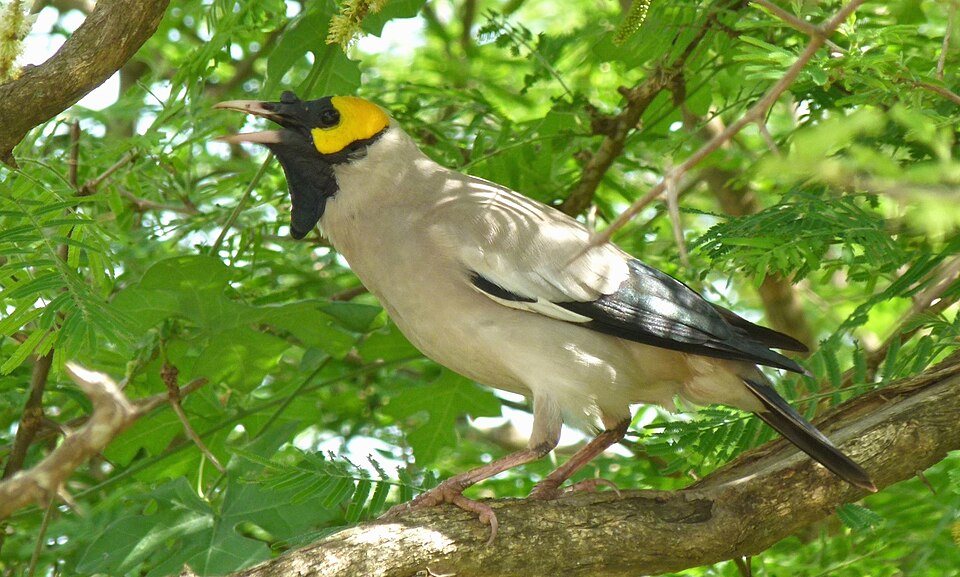
Photo: Bernard DUPONT from FRANCE · CC BY-SA 2.0 (May be cropped or resized)
Creatophora cinerea
Conservation status: Unknown
Basic stats
Diet
Insects, seeds and fruit
Habitat
Savanna and open woodland
Range
Sub-Saharan Africa
Weight
About 73g
Wattled Starlings are glossy dark starlings with pale wing panels and fleshy wattles at the sides of the head. Its AVONET profile lists 73 g, with wing and tail lengths of 118 and 64.4 mm. This species occurs in Sub-Saharan Africa, where Savanna and open woodland is characteristic. For Wattled Starling, a culmen length of 26.3 mm appears in AVONET. (Wikipedia, general species account; AVONET, Tobias et al. 2022)
They forage in savanna and open woodland for insects, seeds and fruit, often gathering in large flocks. Colonies nest in trees and communicate with rattling calls Its diet includes Insects, seeds and fruit, and it forages in Savanna and open woodland. Descriptions link it to Savanna and open woodland throughout Sub-Saharan Africa. EltonTraits gives Wattled Starling its largest diet shares in invertebrates (60%) and fruit (30%). (Wikipedia, general species account; EltonTraits, Wilman et al. 2014)
Where to see Wattled Starling in Kenya
GBIF records grouped by protected area. They show where the species has been reported, not that it is there now, and they are not population counts.
Recorded in 118 protected areas (1965–2026). The 8 with the most records:
- Masai Mara: 1,682 records (1977–2026)
- Nairobi National Park: 856 records (1973–2026)
- Tsavo West National Park: 567 records (1969–2024)
- Tsavo East National Park: 545 records (1969–2025)
- Mara Triangle: 534 records (1988–2026)
- Buffalo Springs National Reserve: 487 records (1969–2024)
- Samburu National Reserve: 484 records (1977–2025)
- Lake Nakuru National Park: 432 records (1969–2024)
Quick answers
- What does the Wattled Starling eat?
- Insects, seeds and fruit
- What habitat does the Wattled Starling live in?
- Savanna and open woodland
- Where is the Wattled Starling found?
- Sub-Saharan Africa
- How much does the Wattled Starling weigh?
- About 73g