
 Wildlife
of Kenya
Tana River Mangabey
Primates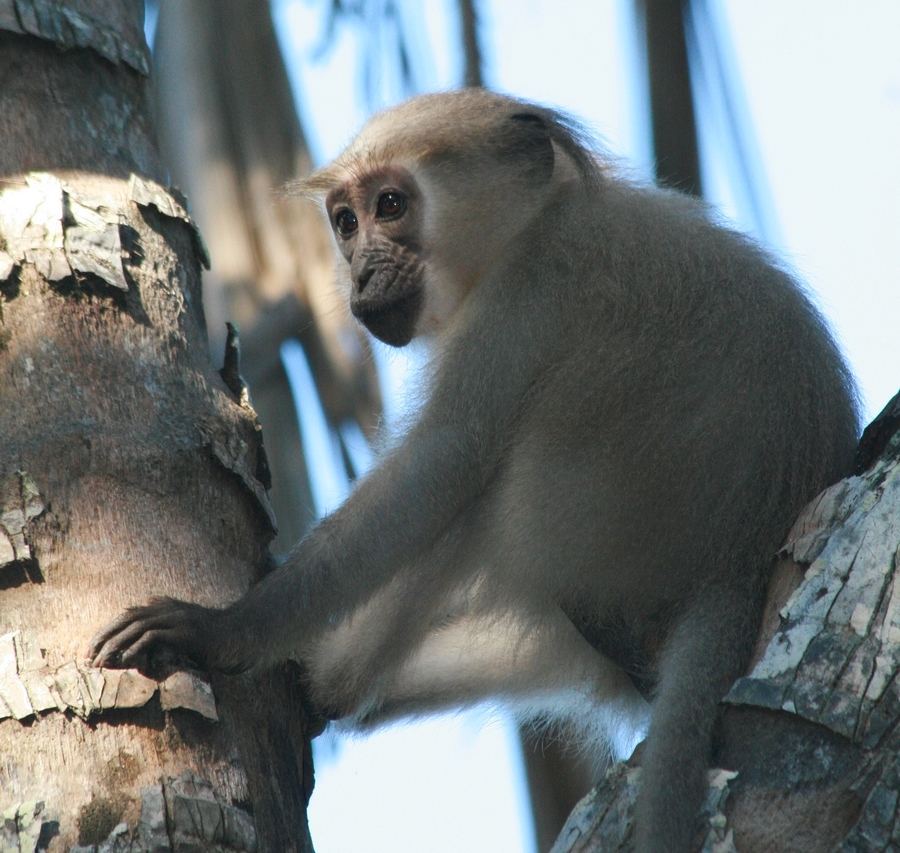
Photo: Michal Sloviak · CC BY 4.0 (May be cropped or resized)
Cercocebus galeritus
Conservation status: Unknown
Basic stats
Diet
Hard nuts, seeds and fruits
Habitat
Dry riparian gallery forest and adjacent bush along the lower Tana River
Range
Lower Tana River, southeastern Kenya
Litter size
1 young
Gestation period
About 180 days
Size
Estimated head and body 50–63cm (males), 42–53cm (females)
Weight
Estimated 8–10kg (males)
The Tana River mangabey is a medium-sized primate with a long, semiprehensile tail and a long, loose, wavy coat that is inconspicuously speckled greyish-yellow or mushroom colour above, with fluffy, yellowish-white underparts. The forearms, hands and feet are dark brown, and the face and ears are black with whitish cheeks and temples and bright white eyelids. A centre parting on the crown has very long, darker hairs diverging on each side. The tail carries a slight pale tuft, particularly in adult males. No specific measurements exist; Kingdon estimates 8–10 kg for males (GBIF description, Cercopithecidae; Wikipedia, general species account). Another name is Tana Mangabey.
It is diurnal, semi-terrestrial and arboreal, spending most of its time on the ground but sleeping in trees 27–37 m tall. It depends heavily on old-growth forest and is endemic to dry riparian gallery forest and adjacent bush along the lower Tana River in southeastern Kenya, where the river's changing course creates a mosaic of forest in different stages. Groups are multimale-multifemale, averaging 27 animals (range 6–62), with a home range of about 47 ha and daily movement around 1,500 m. A single young is born after about 180 days, in November–February, with an interbirth interval of two years (GBIF description, Cercopithecidae; Wikipedia, general species account).
Quick answers
- What does the Tana River Mangabey eat?
- Hard nuts, seeds and fruits
- What habitat does the Tana River Mangabey live in?
- Dry riparian gallery forest and adjacent bush along the lower Tana River
- Where is the Tana River Mangabey found?
- Lower Tana River, southeastern Kenya
- What is the litter size of the Tana River Mangabey?
- 1 young
- How long is the gestation period of the Tana River Mangabey?
- About 180 days
- How big is the Tana River Mangabey?
- Estimated head and body 50–63cm (males), 42–53cm (females)
- How much does the Tana River Mangabey weigh?
- Estimated 8–10kg (males)