
 Wildlife
of Kenya
Striped Roundleaf Bat
Bats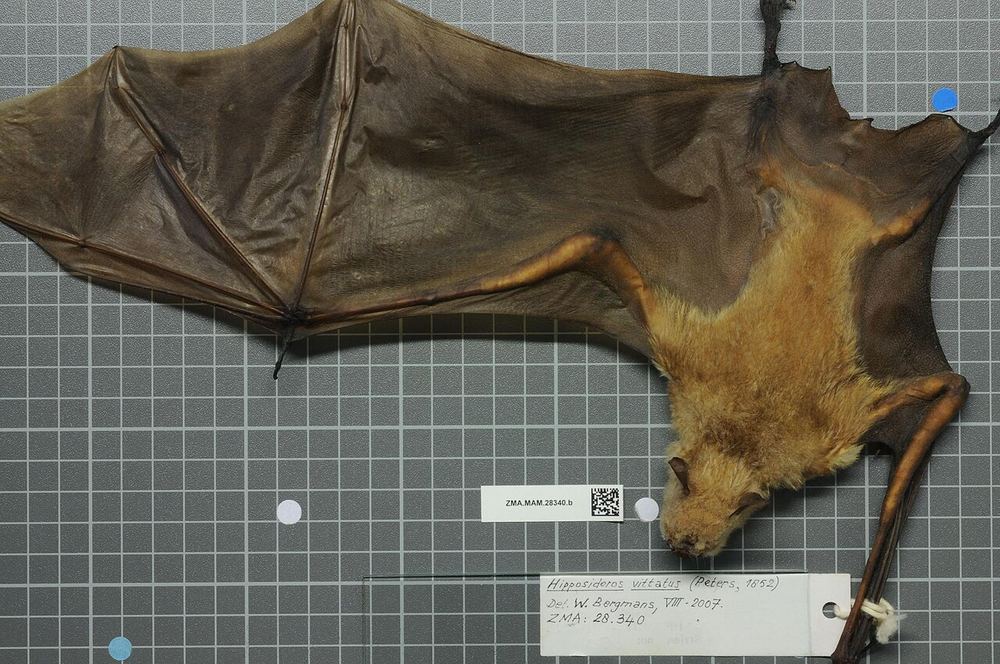
Photo: Wikimedia Commons contributor · CC0
Macronycteris vittata
Conservation status: Unknown
Basic stats
Habitat
Woodland savanna, lowland moist forest and caves
Range
Eastern and southern Africa
Size
Head and body 97–122mm
Weight
51–180g
The striped roundleaf bat is a small bat with dense, short fur that is pale to reddish brown on the back and paler, frosted underneath. Males are larger than females, which have a richer reddish colour. Head and body measure 97–122mm, the tail 22–39mm and the forearm 84–106mm, and weight ranges from 51–180g. Its noseleaf is split into four cells at the rear, with three side leaflets. It was once considered part of M. commersoni, now limited to Madagascar, and both were placed in Hipposideros before molecular evidence led to the revived genus Macronycteris in 2017 (Wikipedia, general species account; GBIF description, Hipposideridae).
Its range covers eastern and southern Africa, from Ethiopia and Somalia south to Zambia and Mozambique, plus Zimbabwe, Botswana and Namibia, with scattered pockets in west and central Africa. It roosts locally in caves and occasionally in trees or under building eaves, favouring woodland savanna and lowland moist forest up to 1,700m. Some populations migrate between coastal and inland sites to track rainfall, and individuals usually forage alone over short flights. Males defend territories for four to five months before mating. A single young is born in a restricted breeding season that varies by region, and females nurse for at least 13 weeks (Wikipedia, general species account; GBIF description, Hipposideridae).
Quick answers
- What habitat does the Striped Roundleaf Bat live in?
- Woodland savanna, lowland moist forest and caves
- Where is the Striped Roundleaf Bat found?
- Eastern and southern Africa
- How big is the Striped Roundleaf Bat?
- Head and body 97–122mm
- How much does the Striped Roundleaf Bat weigh?
- 51–180g