
 Wildlife
of Kenya
Red-billed Buffalo-Weaver
Weavers, Waxbills & Whydahs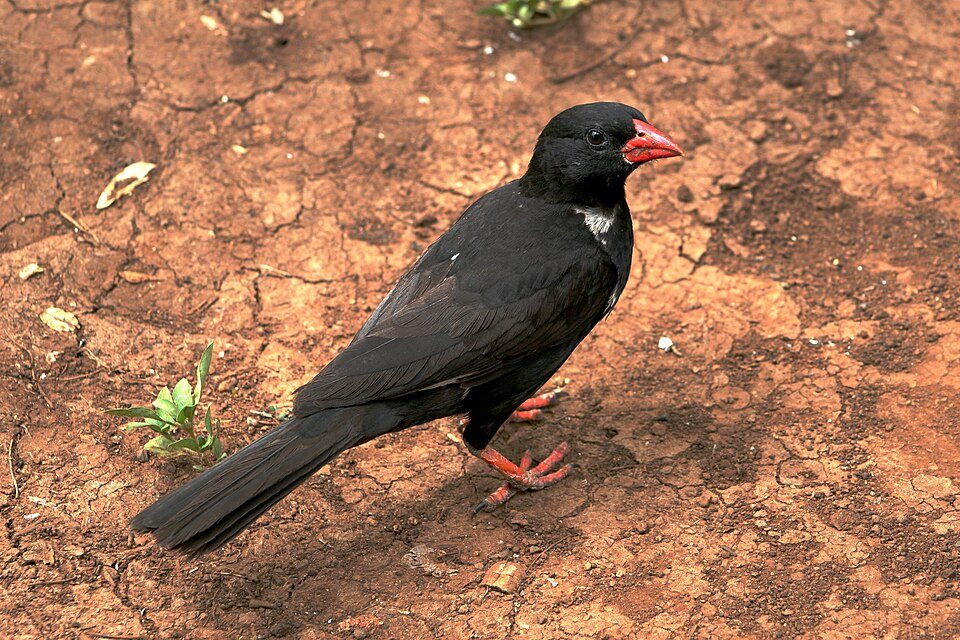
Photo: Greg Tee · CC BY 2.0 (May be cropped or resized)
Bubalornis niger
Conservation status: Unknown
Basic stats
Diet
Seeds and invertebrates
Habitat
Dry savanna and sparse woodland
Range
Eastern and southern Africa
Clutch size
2–4 eggs
Incubation period
About 14 days
Size
About 21–25cm
Weight
Averages about 76g
Red-billed Buffalo-Weavers are large dark-brown weavers about 21–25 cm long and averaging 76 g. Males have red bills and white flecks on the leading edges and tips of their wings; females lack the wing flecking but show broad white margins on the chin and throat feathers. Small family parties and much larger flocks occur, and their voice includes a fast, slightly descending chatter (Wikipedia, general species account; AVONET, Tobias et al. 2022; Collins Birds of the World).
In eastern and southern Africa, Red-billed Buffalo-Weavers favor dry savanna, sparse woodland and places disturbed by people or livestock. Ground foraging yields mostly seeds plus insects, spiders and scorpions. Colonial birds build huge thorny stick nests in trees or on windmills, dividing them into lodges with several grass-lined egg chambers. Females lay two to four eggs and incubate for about 14 days, and young leave after another 20–23 days (Wikipedia, general species account; EltonTraits, Wilman et al. 2014).
Where to see Red-billed Buffalo-Weaver in Kenya
GBIF records grouped by protected area. They show where the species has been reported, not that it is there now, and they are not population counts.
Recorded in 77 protected areas (1906–2026). The 8 with the most records:
- Tsavo West National Park: 1,062 records (1906–2024)
- Tsavo East National Park: 797 records (1969–2026)
- Buffalo Springs National Reserve: 623 records (1969–2026)
- Amboseli National Park: 546 records (1977–2024)
- Samburu National Reserve: 449 records (1973–2026)
- Meru National Park: 304 records (1969–2025)
- Shaba National Reserve: 156 records (1985–2024)
- Taita Hills Wildlife Sanctuary: 110 records (1983–2024)
Quick answers
- What does the Red-billed Buffalo-Weaver eat?
- Seeds and invertebrates
- What habitat does the Red-billed Buffalo-Weaver live in?
- Dry savanna and sparse woodland
- Where is the Red-billed Buffalo-Weaver found?
- Eastern and southern Africa
- How many eggs does the Red-billed Buffalo-Weaver lay?
- 2–4 eggs
- How long are the eggs of the Red-billed Buffalo-Weaver incubated?
- About 14 days
- How big is the Red-billed Buffalo-Weaver?
- About 21–25cm
- How much does the Red-billed Buffalo-Weaver weigh?
- Averages about 76g