
 Wildlife
of Kenya
Red-cheeked Cordonbleu
Weavers, Waxbills & Whydahs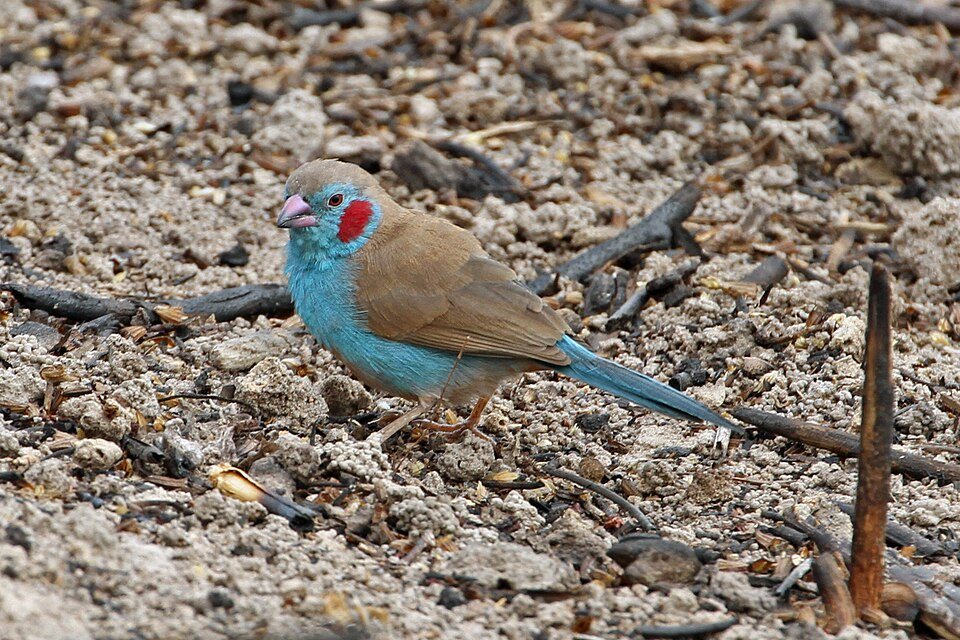
Photo: gisela gerson lohman-braun · CC BY-SA 2.0 (May be cropped or resized)
Uraeginthus bengalus
Conservation status: Unknown
Basic stats
Diet
Grass seeds and other small seeds
Habitat
Open dry grassland and savanna
Range
Central and eastern sub-Saharan Africa
Size
12.5–13cm
Weight
About 10g
Red-cheeked Cordonbleu occupies drier parts of sub-Saharan Africa, from Senegal and Gambia east through the Sahel and Ethiopia, then south into central and eastern Africa. It uses habitats from sea level to 2,430 m but avoids forest interiors, and is often seen in dry grassland, savanna and around people. Adults are just 12.5–13 cm long and average about 10 g. Males show blue from face to breast, flanks and tail, with red cheek patches and light-brown wings. (Wikipedia, general species account; AVONET, Tobias et al. 2022)
Females resemble males but are duller and lack the cheek patch; young birds keep blue mainly on the face and throat. The contact call is a thin, high piping note, while the more elaborate song uses four to six pitches. Females sing too, though less often and with simpler phrases. The species feeds chiefly on grass seeds, along with millet and other small seeds, and may occasionally take beeswax. (Wikipedia, general species account)
Where to see Red-cheeked Cordonbleu in Kenya
GBIF records grouped by protected area. They show where the species has been reported, not that it is there now, and they are not population counts.
Recorded in 135 protected areas (1965–2026). The 8 with the most records:
- Nairobi National Park: 1,964 records (1970–2024)
- Lake Nakuru National Park: 1,568 records (1969–2025)
- Masai Mara: 1,177 records (1973–2026)
- Tsavo West National Park: 506 records (1969–2024)
- Mpala Ranch: 465 records (1996–2025)
- Ol Pejeta Conservancy: 371 records (1989–2026)
- Watamu Marine National Park: 296 records (1973–2024)
- Soysambu Conservancy: 288 records (1993–2026)
Quick answers
- What does the Red-cheeked Cordonbleu eat?
- Grass seeds and other small seeds
- What habitat does the Red-cheeked Cordonbleu live in?
- Open dry grassland and savanna
- Where is the Red-cheeked Cordonbleu found?
- Central and eastern sub-Saharan Africa
- How big is the Red-cheeked Cordonbleu?
- 12.5–13cm
- How much does the Red-cheeked Cordonbleu weigh?
- About 10g