
 Wildlife
of Kenya
Northern Yellow White-eye
Cisticolas, Warblers & White-eyes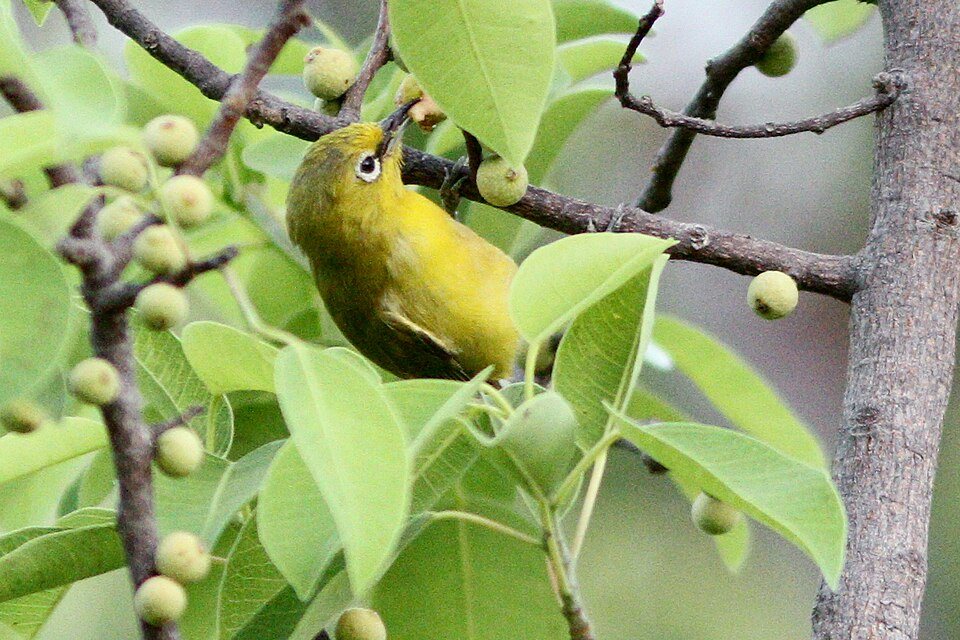
Photo: jujurenoult · CC BY 4.0 (May be cropped or resized)
Zosterops senegalensis
Conservation status: Unknown
Basic stats
Diet
Insects, fruit, nectar and seeds
Habitat
Forest, riverine belts and woodland
Range
Sub-Saharan Africa from Senegal east to Sudan and south to northern Angola
Clutch size
2–4
Incubation period
11–12 days
Size
11.5cm
Weight
11g
Northern Yellow White-eye, formerly called African Yellow White-eye, ranges across sub-Saharan Africa from Senegal east to southern Sudan and south to northern Angola. It was formerly treated as the same species as Angola White-eye. The bird is small and yellow, with a conspicuous white eye-ring, black lores and bill, and brown flight and tail feathers edged olive-yellow. Some subspecies are greener, especially in forest, while juveniles are darker. Length is about 11.5 cm. (Wikipedia, general species account; Collins Birds of the World)
Insects make up much of its food, including caterpillars, aphids and termite alates; it also eats figs and other fruit and takes nectar. It gleans prey from foliage and bark in tree canopies, often in mixed-species flocks. The nest is a small grass-and-twig cup secured with spider web in a tree, around 3.5 m above ground. Two to four eggs are laid from August through January, usually in September and October; both parents incubate for 11–12 days and feed the young, which fledge at about two weeks. The song is a mellow high pipiwee-piriwee, and contact calls are sharp sieeeh notes. (Wikipedia, general species account; Collins Birds of the World; AVONET, Tobias et al. 2022; EltonTraits, Wilman et al. 2014)
Where to see Northern Yellow White-eye in Kenya
GBIF records grouped by protected area. They show where the species has been reported, not that it is there now, and they are not population counts.
Recorded in 48 protected areas (1952–2024). The 8 with the most records:
- Kagamega Forest: 1,294 records (1972–2024)
- Masai Mara: 292 records (1977–2024)
- Masai Moran Conservancy: 216 records (1995–2024)
- Nairobi National Park: 115 records (1975–2024)
- Mara Triangle: 108 records (1977–2024)
- Lake Nakuru National Park: 68 records (2002–2024)
- South Nandi Forest Reserve: 50 records (2011–2024)
- Saiwa Swamp National Park: 49 records (1977–2024)
Quick answers
- What does the Northern Yellow White-eye eat?
- Insects, fruit, nectar and seeds
- What habitat does the Northern Yellow White-eye live in?
- Forest, riverine belts and woodland
- Where is the Northern Yellow White-eye found?
- Sub-Saharan Africa from Senegal east to Sudan and south to northern Angola
- How many eggs does the Northern Yellow White-eye lay?
- 2–4
- How long are the eggs of the Northern Yellow White-eye incubated?
- 11–12 days
- How big is the Northern Yellow White-eye?
- 11.5cm
- How much does the Northern Yellow White-eye weigh?
- 11g