
 Wildlife
of Kenya
Large-eared Slit-faced Bat
Bats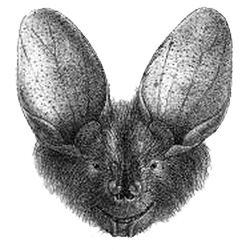
Photo: Dobson, George Edward (1848-1895) · Public domain
Nycteris macrotis
Conservation status: Unknown
Basic stats
Habitat
Forest and savanna, from sea level to about 2,200m
Range
Throughout tropical Africa
Litter size
One
Size
Head and body 60–70mm
Weight
15–18g
The large-eared slit-faced bat is a small Nycteridae with a longitudinal cleft along the top of its muzzle that covers the noseleaves, and very long ears. Its coat is shaggy and pale reddish to greyish above and a little lighter below, though an orange form also occurs that is bright orange on both surfaces. Its wing membranes are dark brown and almost hairless, and there are clear differences in pelage between the sexes. Head and body measure 60–70mm, tail 45–65mm, ear 27–34mm, hindfoot 10–14mm and forearm 40–55mm, with weight 15–18g (GBIF description, Nycteridae; Wikipedia, general species account).
It lives in forests and savannas throughout Africa, from miombo woodland and lowland rainforest to coastal, riverine and grassland savanna. It roosts singly or in small groups, though one roost in Senegal held about 100 individuals. In Malawi and Tanzania there may be two birth peaks each year, though this needs confirmation, and litter size is one. Its range extends from Senegal across Sudan, Ethiopia, Somalia, Kenya and Tanzania, south to north-west Angola (Wikipedia, general species account; GBIF description, Nycteridae).
Where to see Large-eared Slit-faced Bat in Kenya
GBIF records grouped by protected area. They show where the species has been reported, not that it is there now, and they are not population counts.
Recorded in 4 protected areas (1973–2012).
- Arabuko-Sokoke Forest Reserve: 13 records (2006–2012)
- Meru National Park: 5 records
- Tsavo East National Park: 4 records (1973–2007)
- Chyulu Hills: 3 records (2006)
Quick answers
- What habitat does the Large-eared Slit-faced Bat live in?
- Forest and savanna, from sea level to about 2,200m
- Where is the Large-eared Slit-faced Bat found?
- Throughout tropical Africa
- What is the litter size of the Large-eared Slit-faced Bat?
- One
- How big is the Large-eared Slit-faced Bat?
- Head and body 60–70mm
- How much does the Large-eared Slit-faced Bat weigh?
- 15–18g