
 Wildlife
of Kenya
Little Free-tailed Bat
Bats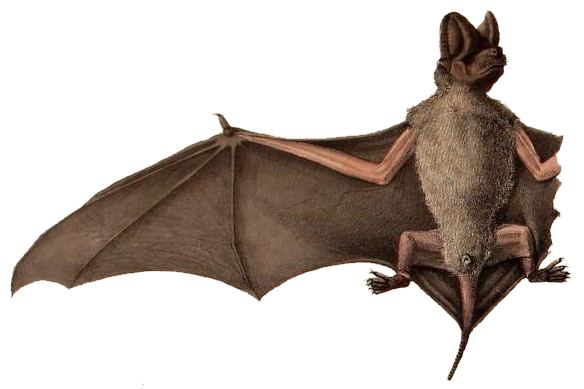
Photo: Rüppell, Eduard, 1794-1884 · Public domain
Mops pumilus
Conservation status: Unknown
Basic stats
Diet
Beetles, true bugs and moths; varies by place and season
Habitat
Open country, from forested south to arid north
Range
Southern Arabian Peninsula, sub-Saharan Africa and nearby islands
Size
Total body length 54–102mm
With a total body length of 54–102mm, this is among the smallest Mops species. Its short dorsal fur is blackish-brown, with a paler underside and pale hairs where the wings meet the flanks. Its round ears are large for its head, and males have a forehead tuft that makes their outline recognisable in flight. Wing and fur colours vary, so white-winged forms from north-eastern Africa differ from dark-winged southern ones, and this has led to different taxonomic designations depending on range (Wikipedia, general species account).
It is found across southern Arabia and sub-Saharan Africa plus Bioko, Zanzibar, Pemba, the Comoros, Madagascar, São Tomé and the Seychelles. It occupies open country, from forested southern zones to arid northern ones, and in Zimbabwe prefers low veld, never climbing onto the plateau above 1,000m. Its diet is mostly beetles, true bugs and moths and butterflies, though the mix shifts between seasons and places. Its flight is fast, suited to the open areas where it usually hunts (Wikipedia, general species account).
Quick answers
- What does the Little Free-tailed Bat eat?
- Beetles, true bugs and moths; varies by place and season
- What habitat does the Little Free-tailed Bat live in?
- Open country, from forested south to arid north
- Where is the Little Free-tailed Bat found?
- Southern Arabian Peninsula, sub-Saharan Africa and nearby islands
- How big is the Little Free-tailed Bat?
- Total body length 54–102mm