
 Wildlife
of Kenya
Large Slit-faced Bat
Bats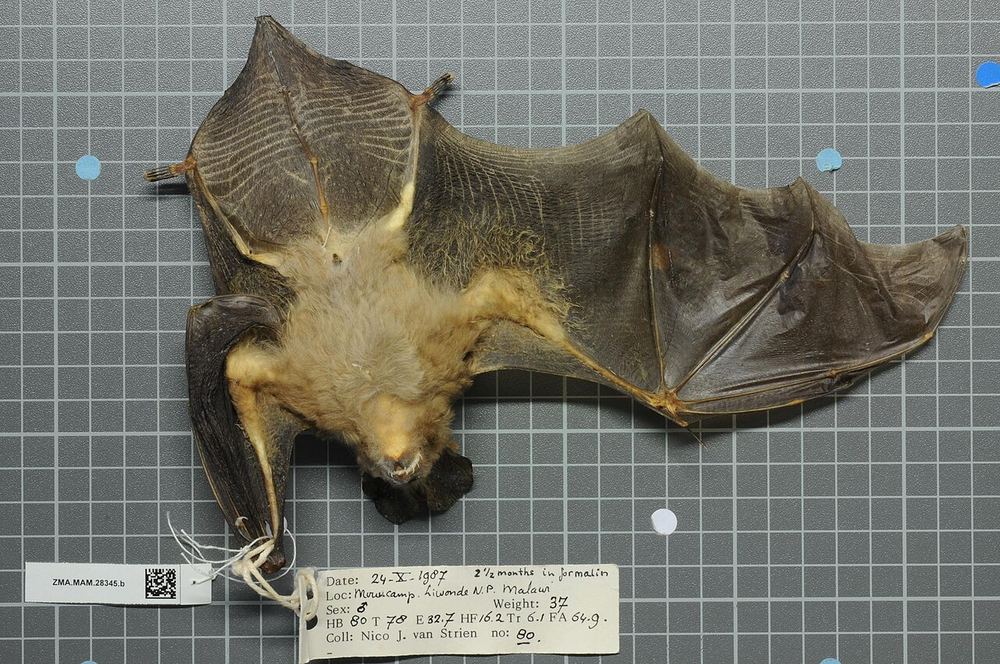
Photo: Wikimedia Commons contributor · CC0
Nycteris grandis
Conservation status: Unknown
Basic stats
Diet
Frogs and fish mainly, with small bats, birds, katydids and crickets
Habitat
Tropical lowland forest and savanna woodland
Range
Tropical Africa, from Senegal to eastern DR Congo
Litter size
One
Size
Head and body 70–90mm
Weight
21–43g
The large slit-faced bat is a medium-sized Nycteridae with short rounded wings, long fluffy fur that is dark reddish in forest populations and grey-brown in savanna ones, with a slightly paler underside. Its ears are very long but relatively short for the group, and its wing membranes are dark brown and almost hairless. Head and body measure 70–90mm, tail 60–84mm, ear 24–35mm and forearm 52–65mm, while weight is 21–43g. The groove on its face, partly covered by the nose-leaf, gives the species its name (Wikipedia, general species account; GBIF description, Nycteridae).
It lives in groups that may number up to 60 bats and spends the day roosting in trees, caves or buildings, returning to the same roost each day. It often hunts from a perch, listening for the wing beats of prey rather than relying on echolocation, though its calls grow louder during a pursuit. It is the only carnivorous bat in Africa, eating mainly frogs and fish, with small bats, birds and crickets also taken. In one study each bat averaged two frogs per night. Pregnant and lactating females have been caught at various times of year, and litter size is one (Wikipedia, general species account; GBIF description, Nycteridae).
Quick answers
- What does the Large Slit-faced Bat eat?
- Frogs and fish mainly, with small bats, birds, katydids and crickets
- What habitat does the Large Slit-faced Bat live in?
- Tropical lowland forest and savanna woodland
- Where is the Large Slit-faced Bat found?
- Tropical Africa, from Senegal to eastern DR Congo
- What is the litter size of the Large Slit-faced Bat?
- One
- How big is the Large Slit-faced Bat?
- Head and body 70–90mm
- How much does the Large Slit-faced Bat weigh?
- 21–43g