
 Wildlife
of Kenya
Knob-billed Duck
Ducks, Geese & Grebes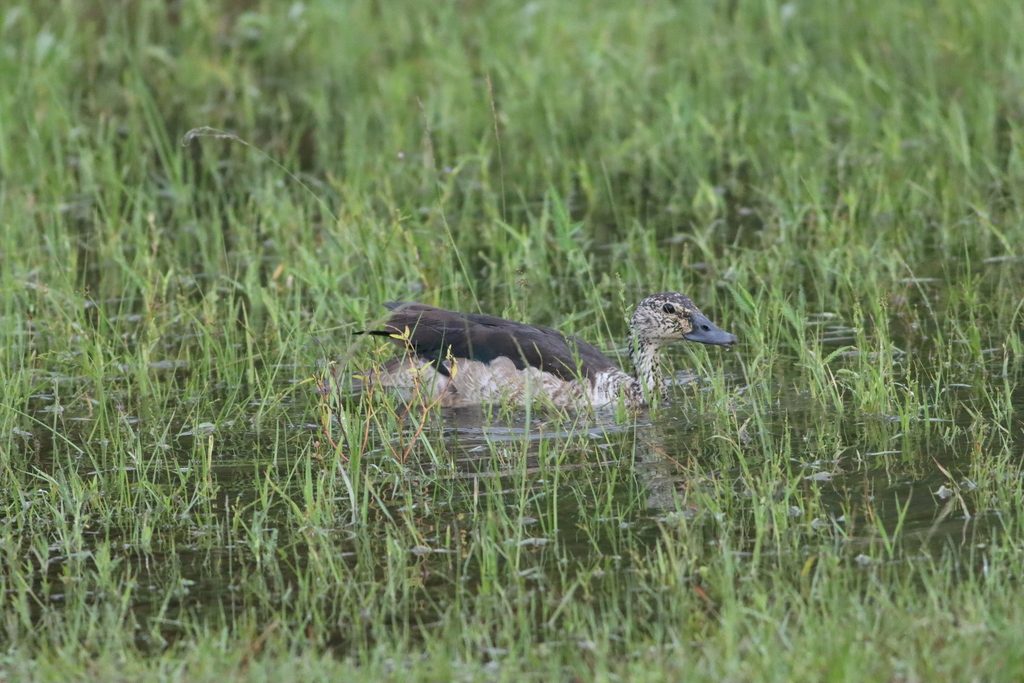
Photo: Vsevolod Rudyi · CC BY 4.0 (May be cropped or resized)
Sarkidiornis melanotos
Conservation status: Unknown
Basic stats
Diet
Aquatic vegetation, seeds and invertebrates
Habitat
Freshwater swamps, lakes and rivers
Range
Sub-Saharan Africa, Madagascar, South Asia and mainland Southeast Asia
Clutch size
7–15 eggs
Size
56–76cm
Wingspan
116–145cm
Weight
Averages about 2610g
The Knob-billed Duck is a large waterfowl species, 56–76 cm long with a 116–145 cm wingspan and an average mass near 2,610 g. Adults have white underparts and a white head flecked with dark markings, contrasting with glossy blue-black upperparts. Males are substantially larger and develop a conspicuous black knob above the bill; females lack this feature (Wikipedia, general species account; AVONET, Tobias et al. 2022).
Across sub-Saharan Africa, Madagascar, South Asia and mainland Southeast Asia, it uses tropical freshwater swamps, lakes and slow waterways. Flocks graze or dabble for aquatic plants and seeds, while invertebrates also contribute substantially to the diet. Birds often perch in trees and disperse with seasonal rains. Nests are commonly placed in tree cavities, though tall grass may also be used, and females lay seven to fifteen eggs (Wikipedia, general species account; EltonTraits, Wilman et al. 2014).
Where to see Knob-billed Duck in Kenya
GBIF records grouped by protected area. They show where the species has been reported, not that it is there now, and they are not population counts.
Recorded in 40 protected areas (1930–2025). The 8 with the most records:
- Arabuko-Sokoke Forest Reserve: 170 records (2000–2024)
- Tsavo East National Park: 132 records (1969–2024)
- Lake Nakuru National Park: 127 records (1969–2024)
- Nairobi National Park: 98 records (1977–2024)
- Masai Mara: 80 records (1976–2024)
- Tsavo West National Park: 76 records (1983–2025)
- Amboseli National Park: 52 records (1985–2024)
- Mara Triangle: 31 records (1977–2023)
Quick answers
- What does the Knob-billed Duck eat?
- Aquatic vegetation, seeds and invertebrates
- What habitat does the Knob-billed Duck live in?
- Freshwater swamps, lakes and rivers
- Where is the Knob-billed Duck found?
- Sub-Saharan Africa, Madagascar, South Asia and mainland Southeast Asia
- How many eggs does the Knob-billed Duck lay?
- 7–15 eggs
- How big is the Knob-billed Duck?
- 56–76cm
- What is the wingspan of the Knob-billed Duck?
- 116–145cm
- How much does the Knob-billed Duck weigh?
- Averages about 2610g