
 Wildlife
of Kenya
Klipspringer
Antelopes & Other Bovids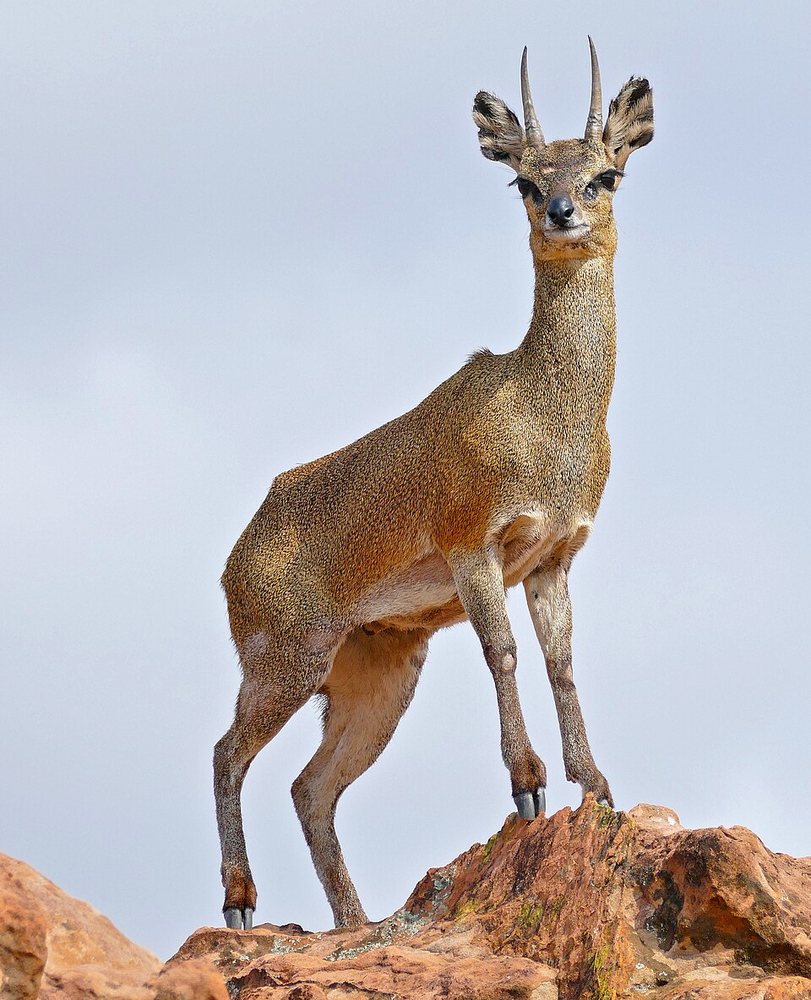
Photo: Bernard DUPONT from FRANCE · CC BY-SA 2.0 (May be cropped or resized)
Oreotragus oreotragus
Conservation status: Unknown
Basic stats
Diet
Young plants, fruits and flowers
Habitat
Rocky terrain with sparse vegetation: kopjes, gorges and rocky hills
Range
Eastern and southern Africa
Litter size
1 calf
Gestation period
About 6 months
Size
Shoulder height 43–60cm; head and body 75–115cm
Weight
8–18kg
The klipspringer is a small, sturdy antelope, 43–60cm at the shoulder, with head and body of 75–115cm and a weight of 8–18kg. Females are slightly larger. The coat is yellowish gray to reddish brown, which camouflages it among rocks, with a white underbelly. Unlike most antelopes the coat is thick and coarse, made of hollow, brittle hairs. Only males have horns, short and spiky, typically 7.5–9cm. The face has a brown forehead, short ears marked with black, prominent preorbital glands and white lips and chin (Wikipedia, general species account).
It lives on rocky ground such as mountains, kopjes and gorges, and runs with a bounding gait from rock to rock. It is most active in the early morning and late afternoon. Klipspringers are territorial: a male and female pair with their young hold a territory, the female marking first and the male overmarking. Territories averaged 15 hectares in the Karoo and 49 in the North West Cape. Gestation is around six months, giving a single calf (GBIF description, Bovidae; Wikipedia, general species account).
Where to see Klipspringer in Kenya
GBIF records grouped by protected area. They show where the species has been reported, not that it is there now, and they are not population counts.
Recorded in 3 protected areas (1996–2024).
- Chyulu Hills: 5 records (2015)
- Lake Nakuru National Park: 4 records (1996–2000)
- Tsavo West National Park: 3 records (2015–2024)
Quick answers
- What does the Klipspringer eat?
- Young plants, fruits and flowers
- What habitat does the Klipspringer live in?
- Rocky terrain with sparse vegetation: kopjes, gorges and rocky hills
- Where is the Klipspringer found?
- Eastern and southern Africa
- What is the litter size of the Klipspringer?
- 1 calf
- How long is the gestation period of the Klipspringer?
- About 6 months
- How big is the Klipspringer?
- Shoulder height 43–60cm; head and body 75–115cm
- How much does the Klipspringer weigh?
- 8–18kg