
 Wildlife
of Kenya
Garnett's Greater Galago
Primates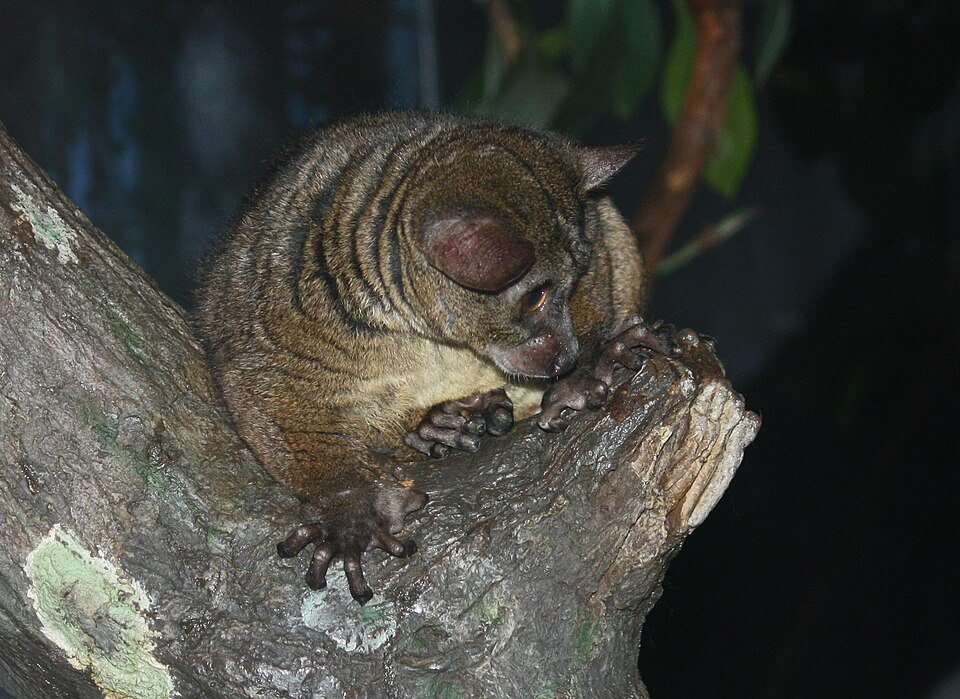
Photo: Ltshears · CC BY-SA 3.0 (May be cropped or resized)
Otolemur garnettii
Conservation status: Unknown
Basic stats
Diet
Gum, fruit and insects
Habitat
Coastal, riparian, montane and highland forest, sea level to 2,500m
Range
Coastal East Africa from the Juba to the Ruvuma River, the Kenyan highlands, Zanzibar and Pemba
Litter size
1, rarely 2
Gestation period
About 130 days
Size
Head and body 23–34cm; tail 30–44cm
Weight
0.5–1kg (mean about 0.75kg)
Garnett's greater galago, or the northern greater galago, is large for a galago but much smaller than the thick-tailed greater galago, with a pointed muzzle and short ears. Head and body measure 23–34cm and the tail 30–44cm, and weight is 0.5–1kg, averaging about 0.75kg. Males are roughly 18–19% heavier than females. The fur is grayish-brown to reddish, varying by subspecies, and the bushy tail has a brown, black or white tip (GBIF description, Galagidae; Wikipedia, general species account).
It lives in coastal and riverine forest and the Kenyan highland forests from sea level to 2,500m, and in coconut and clove plantations and secondary forest. It is nocturnal and mainly arboreal, and does not live in woodland savanna. By day it sleeps in tangled vegetation. Males are mainly solitary, with home ranges of about 17ha. One young, rarely two, is born each year, typically in August–October after about 130 days. Weaning takes place at about 140 days (GBIF description, Galagidae; Wikipedia, general species account).
Where to see Garnett's Greater Galago in Kenya
GBIF records grouped by protected area. They show where the species has been reported, not that it is there now, and they are not population counts.
Recorded in 2 protected areas (1948–2025).
- Mount Kenya National Park: 4 records (1948–1950)
- Shimba Hills National Reserve: 4 records (2013–2025)
Quick answers
- What does the Garnett's Greater Galago eat?
- Gum, fruit and insects
- What habitat does the Garnett's Greater Galago live in?
- Coastal, riparian, montane and highland forest, sea level to 2,500m
- Where is the Garnett's Greater Galago found?
- Coastal East Africa from the Juba to the Ruvuma River, the Kenyan highlands, Zanzibar and Pemba
- What is the litter size of the Garnett's Greater Galago?
- 1, rarely 2
- How long is the gestation period of the Garnett's Greater Galago?
- About 130 days
- How big is the Garnett's Greater Galago?
- Head and body 23–34cm; tail 30–44cm
- How much does the Garnett's Greater Galago weigh?
- 0.5–1kg (mean about 0.75kg)