
 Wildlife
of Kenya
Common Naked Mole-rat
Rodents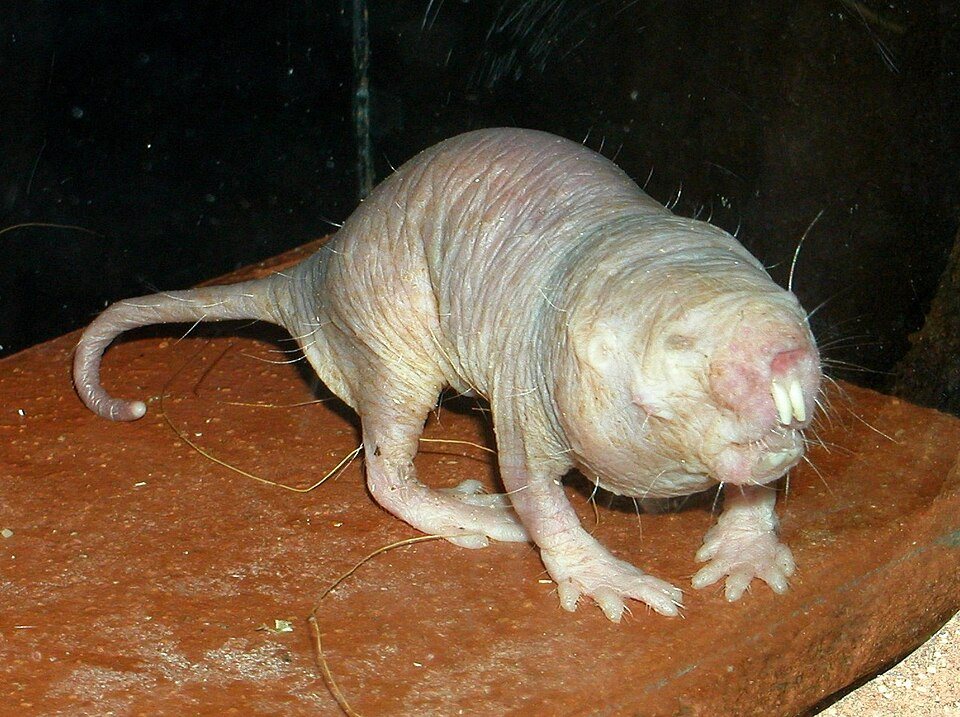
Photo: Roman Klementschitz, Wien · CC BY-SA 3.0 (May be cropped or resized)
Heterocephalus glaber
Conservation status: Unknown
Basic stats
Diet
Bulbs, roots and tubers from closed underground burrows
Habitat
Subterranean arid bushland, thicket and semi-desert with 200–400mm annual rainfall
Range
Horn of Africa and parts of Kenya
Litter size
1–28 young
Gestation period
66–74 days
Size
8–10cm long
Weight
30–35g
The common naked mole-rat, also called the sand puppy, is a burrowing rodent native to the Horn of Africa and parts of Kenya. It is the only species in the genus Heterocephalus. Typical adults are 8–10cm long and weigh 30–35g, while breeding females can exceed 50g. Its eyes are tiny with poor visual acuity, and its thin, short legs allow fast movement backward underground. Large protruding teeth do the digging, with lips sealed just behind them to keep soil out. It has little hair and wrinkled pink or yellowish skin without an insulating layer. Although closely related to the blesmols, it is placed in its own family, Heterocephalidae (Wikipedia, general species account).
It lives in arid bushland, thicket and semi-desert with low, irregular rainfall of roughly 200–400mm a year, at elevations of 300–1500m, and it is the only subterranean rodent in its range. It is eusocial, living in colonies of 40–80 individuals with one reproductive female and one or two breeding males, while other members are suppressed. Gestation lasts 66–74 days with litters of one to 28 young, and dominant females may have litters every 76–84 days. It feeds on bulbs, roots and tubers inside its underground burrows, and it survives at least five hours in air containing only 5% oxygen (GBIF description, Heterocephalidae; Wikipedia, general species account).
Quick answers
- What does the Common Naked Mole-rat eat?
- Bulbs, roots and tubers from closed underground burrows
- What habitat does the Common Naked Mole-rat live in?
- Subterranean arid bushland, thicket and semi-desert with 200–400mm annual rainfall
- Where is the Common Naked Mole-rat found?
- Horn of Africa and parts of Kenya
- What is the litter size of the Common Naked Mole-rat?
- 1–28 young
- How long is the gestation period of the Common Naked Mole-rat?
- 66–74 days
- How big is the Common Naked Mole-rat?
- 8–10cm long
- How much does the Common Naked Mole-rat weigh?
- 30–35g