
 Wildlife
of Kenya
Cape Teal
Ducks, Geese & Grebes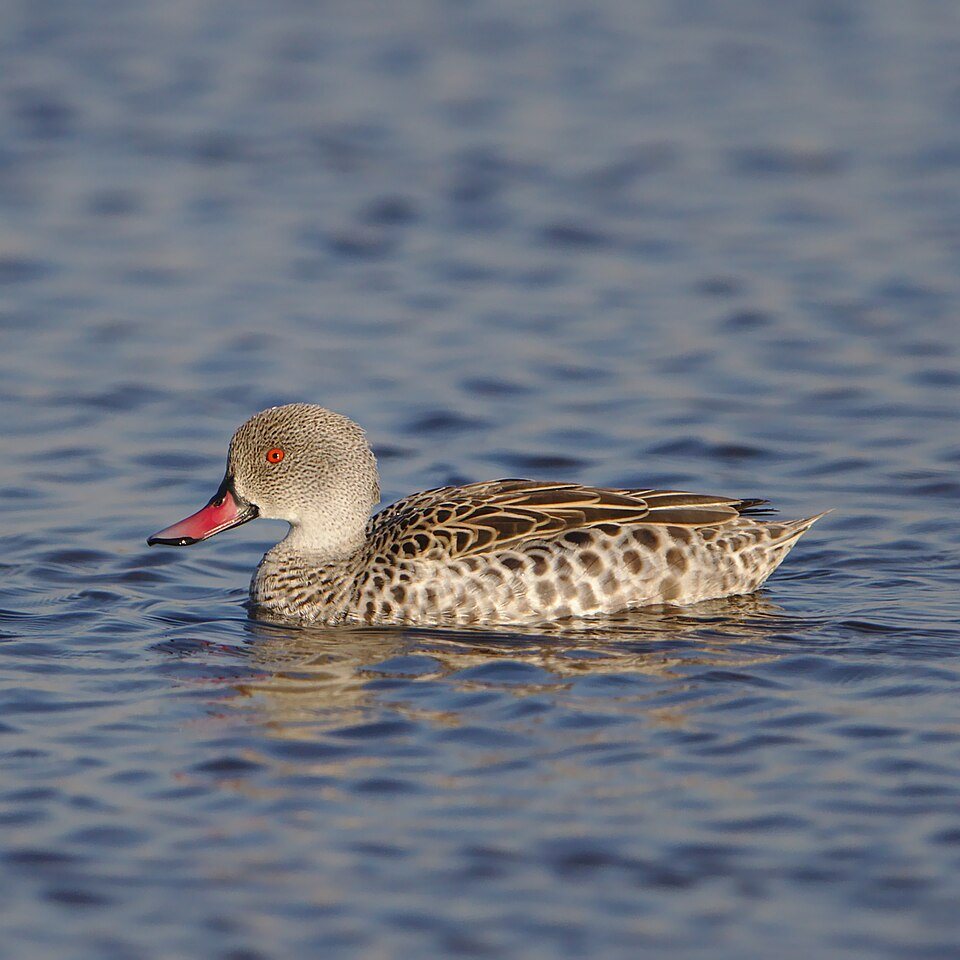
Photo: Derek Keats from Johannesburg, South Africa · CC BY 2.0 (May be cropped or resized)
Anas capensis
Conservation status: Unknown
Basic stats
Diet
Aquatic plants and small invertebrates
Habitat
Open wetlands
Range
Sub-Saharan Africa
Size
44–46cm
The Cape Teal is a 44–46 cm dabbling duck of open wetlands in sub-Saharan Africa. Its sexes look alike: the plumage is mostly grey, the back is browner, and adults show pink on the bill, unlike young birds. Outside mating displays, the Cape Teal is generally quiet. Its overall coloring is very pale. Its pale head contrasts with a black-based red bill. (Wikipedia, general species account; Collins Birds of the World)
It is mostly resident but shifts in response to rainfall, and large gatherings are uncommon outside moulting flocks, which can number as many as 2,000. The duck obtains aquatic plants, invertebrates, crustaceans, and amphibians by dabbling; it nests on the ground beneath vegetation near water. Males whistle during breeding display, while females give a weak quack. (Wikipedia, general species account; AVONET, Tobias et al. 2022)
Where to see Cape Teal in Kenya
GBIF records grouped by protected area. They show where the species has been reported, not that it is there now, and they are not population counts.
Recorded in 16 protected areas (1963–2026). The 8 with the most records:
- Lake Nakuru National Park: 1,016 records (1963–2026)
- Soysambu Conservancy: 211 records (1993–2024)
- Lake Bogoria National Reserve: 136 records (1981–2023)
- Amboseli National Park: 107 records (1999–2024)
- Nairobi National Park: 13 records (1999–2023)
- Sangare Conservancy: 9 records (1996–2010)
- Aberdare Country Club Sanctuary Conservancy: 7 records (1996–2002)
- Crater Lake Conservancy: 7 records (2001–2023)
Quick answers
- What does the Cape Teal eat?
- Aquatic plants and small invertebrates
- What habitat does the Cape Teal live in?
- Open wetlands
- Where is the Cape Teal found?
- Sub-Saharan Africa
- How big is the Cape Teal?
- 44–46cm