
 Wildlife
of Kenya
White-winged Widowbird
Weavers, Waxbills & Whydahs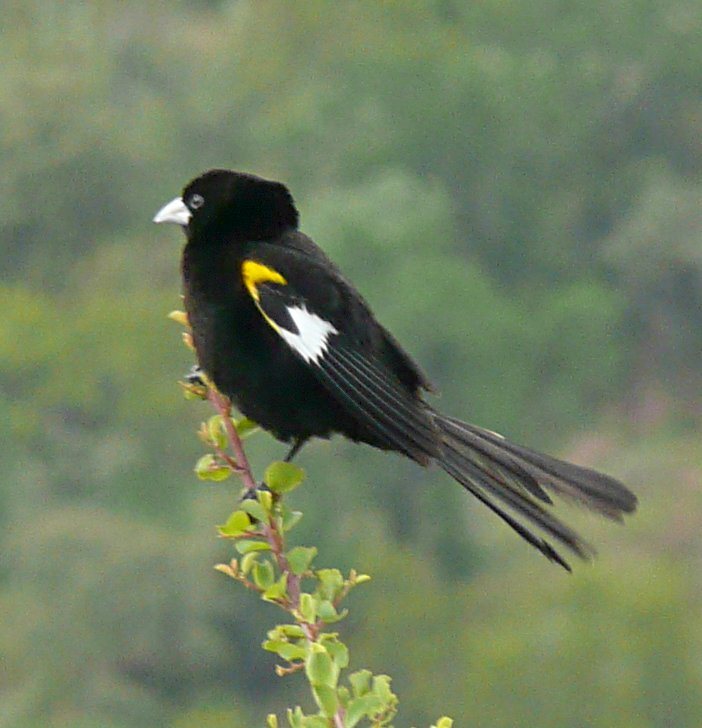
Photo: Renke Rommerskirchen · CC BY-SA 3.0 (May be cropped or resized)
Euplectes albonotatus
Conservation status: Unknown
Basic stats
Diet
Seeds, invertebrates and nectar
Habitat
Savanna, grassland, wetlands and cultivated land
Range
Sub-Saharan Africa
Clutch size
2–4 eggs
Incubation period
12–14 days
Weight
Averages about 21g
The White-winged Widowbird is 15–19 cm long and weighs about 23 g in the species account; AVONET records an average mass of about 21 g, with mean wing length of 72.7 mm and mean tail length of 63.2 mm. Breeding males become dark and gain more white in the wings, while females remain predominantly pale (Wikipedia, general species account; AVONET, Tobias et al. 2022).
It occurs across sub-Saharan Africa in savanna, grassland, wetlands and cultivated land. Seeds contribute 70% of the diet profile, invertebrates 20% and nectar 10%. The species lives in flocks, and a female incubates two to four white eggs for 12–14 days in an oval nest built by the male. This combines open-country feeding with a distinctive nesting system (Wikipedia, general species account; EltonTraits, Wilman et al. 2014).
Where to see White-winged Widowbird in Kenya
GBIF records grouped by protected area. They show where the species has been reported, not that it is there now, and they are not population counts.
Recorded in 59 protected areas (1965–2026). The 8 with the most records:
- Nairobi National Park: 1,295 records (1973–2026)
- Tsavo West National Park: 419 records (1973–2024)
- Masai Mara: 362 records (1977–2026)
- Amboseli National Park: 141 records (1998–2024)
- Mara Triangle: 116 records (1987–2026)
- Tsavo East National Park: 96 records (1966–2024)
- Buffalo Springs National Reserve: 80 records (1990–2024)
- Meru National Park: 44 records (1976–2024)
Quick answers
- What does the White-winged Widowbird eat?
- Seeds, invertebrates and nectar
- What habitat does the White-winged Widowbird live in?
- Savanna, grassland, wetlands and cultivated land
- Where is the White-winged Widowbird found?
- Sub-Saharan Africa
- How many eggs does the White-winged Widowbird lay?
- 2–4 eggs
- How long are the eggs of the White-winged Widowbird incubated?
- 12–14 days
- How much does the White-winged Widowbird weigh?
- Averages about 21g