
 Wildlife
of Kenya
Vulturine Guineafowl
Guineafowl, Francolins & Quails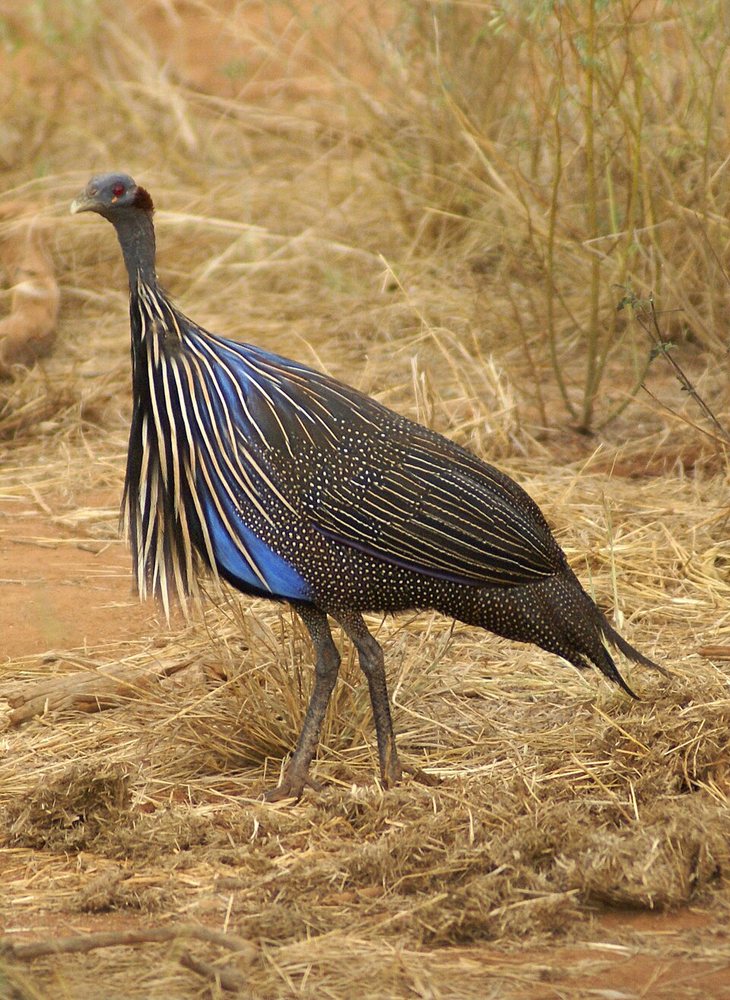
Photo: putneymark · CC BY-SA 2.0 (May be cropped or resized)
Acryllium vulturinum
Conservation status: Unknown
Basic stats
Diet
Plants, seeds, fruit and invertebrates
Habitat
Dry savanna and grassland with scattered trees
Range
Northeastern Africa
Clutch size
4–8 eggs
Size
61–71cm
Weight
1–1.6kg
Vulturine Guineafowl are the largest living guinea fowl, with bare blue faces, long black necks, glossy blue-and-white hackles, cobalt breasts and black plumage finely spangled with white. They measure 61–71 cm and weigh about 1–1.6 kg (Wikipedia, general species account; AVONET, Tobias et al. 2022).
Vulturine Guineafowl form flocks of about 25 outside the breeding season and run rather than fly when alarmed. They feed on seeds, fruit, plants and small invertebrates, roost in trees, and lay four to eight cream eggs in a hidden grass-lined scrape in dry open country (Wikipedia, general species account; EltonTraits, Wilman et al. 2014).
Where to see Vulturine Guineafowl in Kenya
GBIF records grouped by protected area. They show where the species has been reported, not that it is there now, and they are not population counts.
Recorded in 51 protected areas (1930–2026). The 8 with the most records:
- Samburu National Reserve: 1,489 records (1970–2026)
- Buffalo Springs National Reserve: 1,109 records (1969–2026)
- Mpala Ranch: 903 records (1996–2026)
- Tsavo West National Park: 607 records (1969–2025)
- Tsavo East National Park: 411 records (1969–2026)
- Shaba National Reserve: 151 records (1978–2024)
- Nasuulu Community Conservancy: 143 records (1982–2026)
- Ol Jogi Conservancy: 129 records (1998–2025)
Quick answers
- What does the Vulturine Guineafowl eat?
- Plants, seeds, fruit and invertebrates
- What habitat does the Vulturine Guineafowl live in?
- Dry savanna and grassland with scattered trees
- Where is the Vulturine Guineafowl found?
- Northeastern Africa
- How many eggs does the Vulturine Guineafowl lay?
- 4–8 eggs
- How big is the Vulturine Guineafowl?
- 61–71cm
- How much does the Vulturine Guineafowl weigh?
- 1–1.6kg