
 Wildlife
of Kenya
Southern Ground-Hornbill
Hornbills & Hoopoes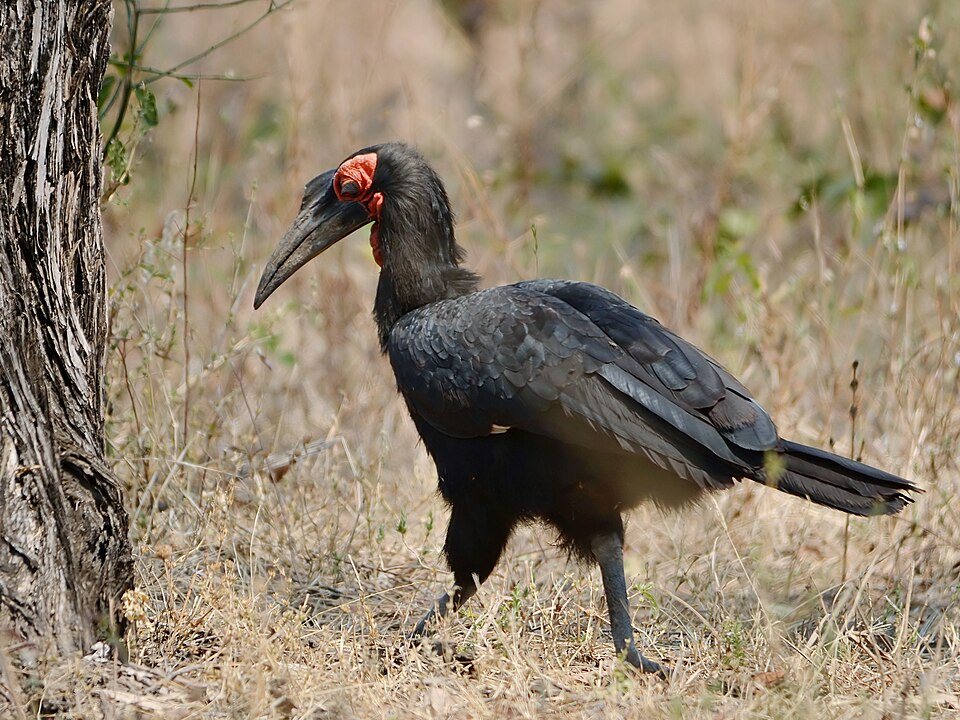
Photo: Hans Hillewaert · CC BY-SA 3.0 (May be cropped or resized)
Bucorvus leadbeateri
Conservation status: Unknown
Basic stats
Diet
Large insects, reptiles, birds and small mammals
Habitat
Open savanna and woodland with large nest trees
Clutch size
Usually 2 eggs, but normally one chick survives
Size
Roughly 90–130cm long
The southern ground-hornbill is a huge black bird with white primary feathers visible in flight and bare red skin on the face and throat. Females have a blue patch on the throat; males are entirely red there. It walks heavily through grassland and woodland and gives a deep booming call that can carry for kilometres (AVONET, Tobias et al. 2022; Wikipedia, general species account).
Family groups cooperate to defend a large territory and raise a single chick in a tree cavity. On the ground they take insects, snakes, lizards, birds and small mammals, sometimes working together around fires or grazing animals. In Kenya the species is most associated with southern savannas such as the Maasai Mara and Tsavo. No sourced Kenya national Red List classification is attached, so status is unknown.
Where to see Southern Ground-Hornbill in Kenya
GBIF records grouped by protected area. They show where the species has been reported, not that it is there now, and they are not population counts.
Recorded in 29 protected areas (1969–2025). The 8 with the most records:
- Masai Mara: 2,172 records (1971–2024)
- Mara Triangle: 729 records (1971–2024)
- Lake Nakuru National Park: 278 records (1969–2024)
- Tsavo East National Park: 265 records (1969–2025)
- Tsavo West National Park: 153 records (1969–2024)
- Masai Moran Conservancy: 116 records (2007–2024)
- Amboseli National Park: 64 records (1973–2022)
- Mara North Conservancy: 64 records (1977–2025)
Quick answers
- What does the Southern Ground-Hornbill eat?
- Large insects, reptiles, birds and small mammals
- What habitat does the Southern Ground-Hornbill live in?
- Open savanna and woodland with large nest trees
- How many eggs does the Southern Ground-Hornbill lay?
- Usually 2 eggs, but normally one chick survives
- How big is the Southern Ground-Hornbill?
- Roughly 90–130cm long