
 Wildlife
of Kenya
Southern Giant Pouched Rat
Rodents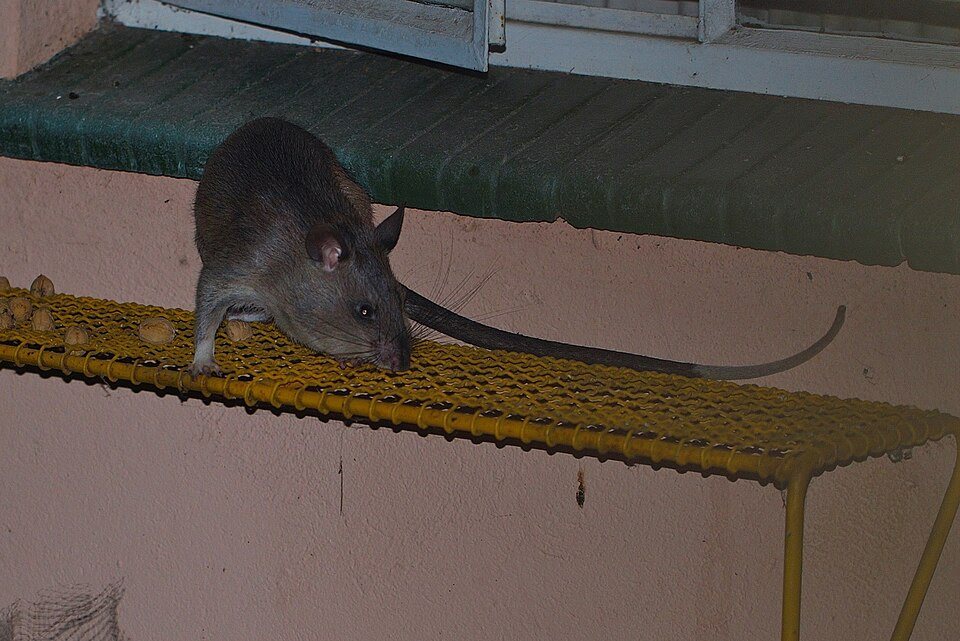
Photo: (c) i_c_riddell, some rights reserved (CC BY) · CC BY 4.0 (May be cropped or resized)
Cricetomys ansorgei
Conservation status: Unknown
Basic stats
Habitat
Wide range of savanna, woodland and forest; often lives near people in urban areas
Range
Savanna of East and Southern Africa, including Zimbabwe, Kenya, Tanzania, Zambia and the Democratic Republic of Congo
Litter size
Usually 1–3 young
Gestation period
27–42 days (GBIF)
Size
Head and body 288–413mm, tail 345–449mm
The southern giant pouched rat, Cricetomys ansorgei, is a large rodent in the family Nesomyidae. Its fur is long and harsh to the touch, dark brown or grayish brown on the back and white or cream below. Its snout is long and tapering, and its eyes are circled by dark rings, its ears are relatively long, and its tail is slightly longer than its head and body, with the far half white against a dark near half. Males are larger than females. Its oversized cheek pouches are used to carry food back to the burrow (GBIF description, Nesomyidae; Wikipedia, general species account).
It is widely distributed across mainly tropical southern Africa, and occupies a wide range of savanna, woodland and forest. It frequently lives alongside people, reaching high densities in some urban areas, and it digs burrows mainly with its teeth, usually at the base of large trees or boulders. It is usually solitary, with one animal per burrow system, and home ranges average 4–9ha. Pregnant females are mostly recorded in the rainy season, with usually 1–3 young per litter. APOPO uses the species for tuberculosis and landmine detection, and it is also popular as bushmeat (Wikipedia, general species account; GBIF description, Nesomyidae).
Quick answers
- What habitat does the Southern Giant Pouched Rat live in?
- Wide range of savanna, woodland and forest; often lives near people in urban areas
- Where is the Southern Giant Pouched Rat found?
- Savanna of East and Southern Africa, including Zimbabwe, Kenya, Tanzania, Zambia and the Democratic Republic of Congo
- What is the litter size of the Southern Giant Pouched Rat?
- Usually 1–3 young
- How long is the gestation period of the Southern Giant Pouched Rat?
- 27–42 days (GBIF)
- How big is the Southern Giant Pouched Rat?
- Head and body 288–413mm, tail 345–449mm