
 Wildlife
of Kenya
Smith's Red Rock Hare
Hares & Rabbits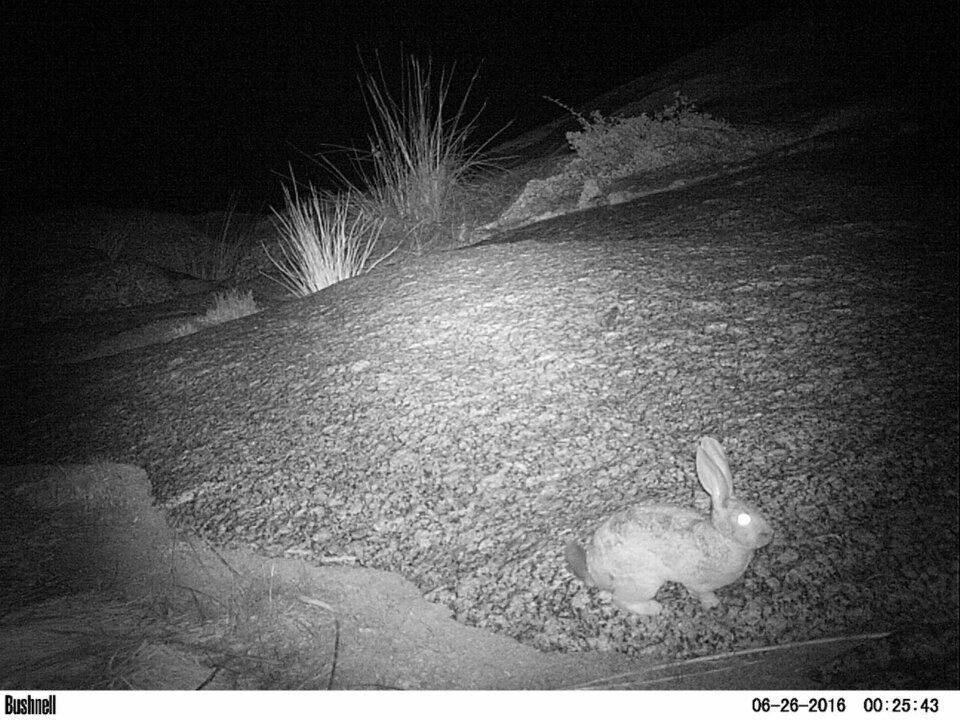
Photo: Kevin Murray · CC BY 4.0 (May be cropped or resized)
Pronolagus rupestris
Conservation status: Unknown
Basic stats
Diet
Mainly grasses, with shrubs and herbs
Habitat
Rocky slopes, outcrops, ravines and boulder-strewn hillsides
Range
Rift Valley of Kenya, Lesotho, Malawi, eastern Zimbabwe, South Africa, Tanzania and Zambia
Litter size
One or two offspring
Smith's red rock hare is the smallest member of its genus and has reddish-brown upperparts and a reddish-brown throat collar. Its ears are grey, its hind legs and rump bright reddish-brown, and its back has thick, grizzled brown hairs over finer tawny underfur. Its tail is bushy, dark to reddish-brown with a black tip, and its underparts are pinkish buff with some white along the belly. Length and weight are not stated, because Wikipedia and GBIF differ on both. It resembles Jameson's red rock hare, which has shorter ears and a longer tail (Wikipedia, general species account; GBIF description, Leporidae).
It occurs in parts of Kenya's Rift Valley, Lesotho, Malawi, eastern Zimbabwe, South Africa, Tanzania and Zambia, on rocky slopes and the tops of outcrops where grass, rocks and bush mix. It uses ravines with boulders and rock crevices for cover. Although nocturnal, it sometimes appears in early morning or late afternoon where it is not hunted. It forages on grasses, especially sprouting grass, and on shrubs and herbs. It breeds from September to February and usually has one or two offspring, which leave the nest after about three years. GBIF adds that it tends to occur at lower altitudes than Hewitt's red rock hare within South Africa (Wikipedia, general species account; GBIF description, Leporidae).
Quick answers
- What does the Smith's Red Rock Hare eat?
- Mainly grasses, with shrubs and herbs
- What habitat does the Smith's Red Rock Hare live in?
- Rocky slopes, outcrops, ravines and boulder-strewn hillsides
- Where is the Smith's Red Rock Hare found?
- Rift Valley of Kenya, Lesotho, Malawi, eastern Zimbabwe, South Africa, Tanzania and Zambia
- What is the litter size of the Smith's Red Rock Hare?
- One or two offspring