
 Wildlife
of Kenya
Mosque Swallow
Other Songbirds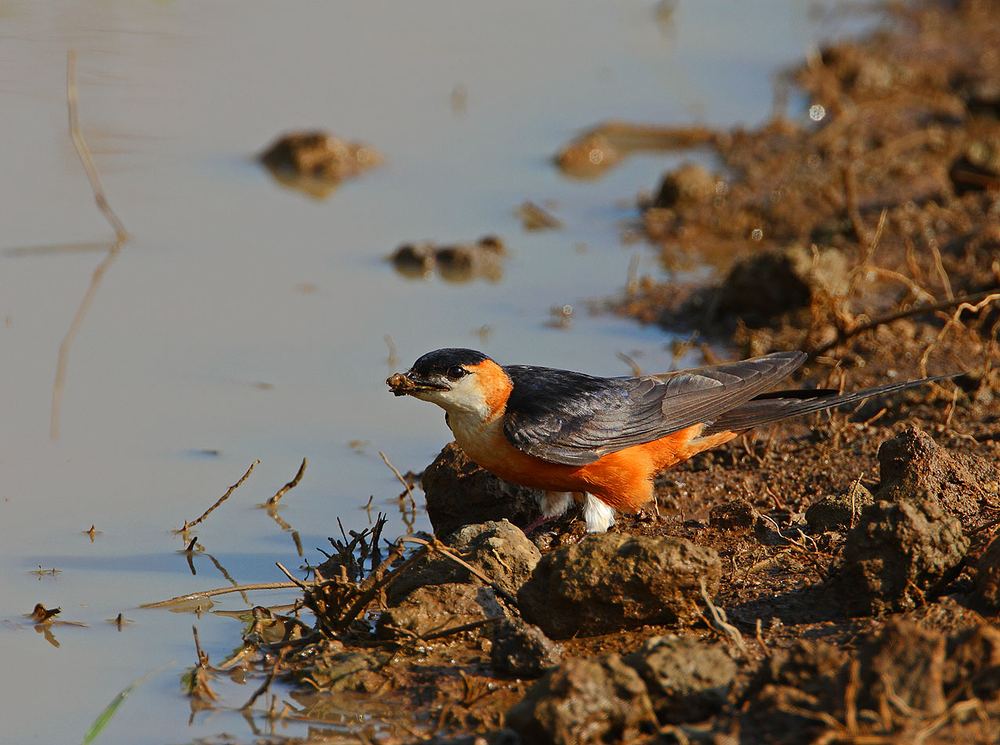
Photo: https://www.flickr.com/photos/rainbirder · CC BY 2.0 (May be cropped or resized)
Cecropis senegalensis
Conservation status: Unknown
Basic stats
Diet
Flying insects
Habitat
Woodland, savanna and forest clearings
Range
Sub-Saharan Africa
Clutch size
2–4 eggs
Size
About 21–23cm
Weight
Averages about 45g
Mosque Swallows are Africa's largest swallows, measuring 21–23 cm and weighing roughly 45 g. Glossy dark-blue crowns, backs and tails contrast with whitish facial collars, dark-rufous rumps and rufous underparts; pale underwing coverts stand out against dark flight feathers. Females resemble males but have shorter streamers. Their rambling discordant song is joined by a brief nasal call (Wikipedia, general species account; AVONET, Tobias et al. 2022; Collins Birds of the World).
From Senegal and southern Mauritania east to South Sudan and south into Namibia, Botswana and South Africa, Mosque Swallows occupy woodland, savanna, clearings and settlements. They glide with slow falcon-like flight while catching ants, termites and flies 2–30 m above ground, gathering around fires or termite emergences. Gourd-shaped mud nests with long tunnels are built in cavities, branches, buildings or culverts. Clutches contain two to four eggs, with breeding possible year-round (Wikipedia, general species account; EltonTraits, Wilman et al. 2014).
Where to see Mosque Swallow in Kenya
GBIF records grouped by protected area. They show where the species has been reported, not that it is there now, and they are not population counts.
Recorded in 67 protected areas (1969–2026). The 8 with the most records:
- Masai Mara: 968 records (1972–2026)
- Lake Nakuru National Park: 350 records (1969–2024)
- Mara Triangle: 318 records (1977–2024)
- Mount Kenya National Reserve: 231 records (1984–2024)
- Amboseli National Park: 170 records (1977–2024)
- Aberdare National Park: 137 records (1973–2024)
- Masai Moran Conservancy: 121 records (1995–2024)
- Mpala Ranch: 98 records (1996–2024)
Quick answers
- What does the Mosque Swallow eat?
- Flying insects
- What habitat does the Mosque Swallow live in?
- Woodland, savanna and forest clearings
- Where is the Mosque Swallow found?
- Sub-Saharan Africa
- How many eggs does the Mosque Swallow lay?
- 2–4 eggs
- How big is the Mosque Swallow?
- About 21–23cm
- How much does the Mosque Swallow weigh?
- Averages about 45g