
 Wildlife
of Kenya
Horus Swift
Nightjars & Swifts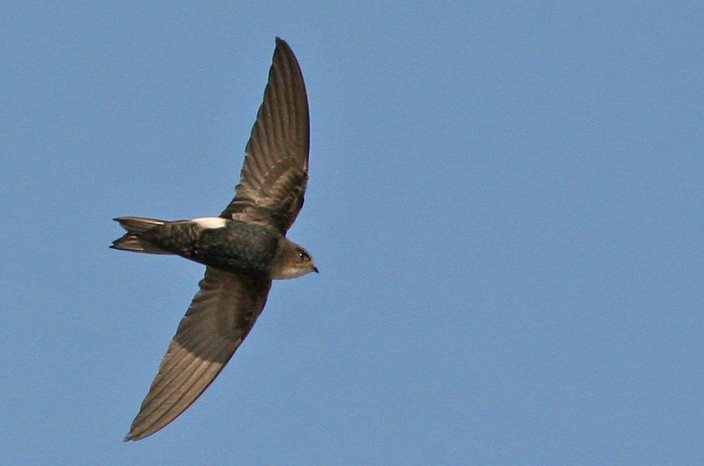
Photo: Robert Wienand, Chloorkop, South Africa · CC BY-SA 3.0 (May be cropped or resized)
Apus horus
Conservation status: Unknown
Basic stats
Diet
Invertebrates
Habitat
Shrubland, sandy banks and open airspace
Range
Sub-Saharan Africa
Clutch size
1–4 eggs
Incubation period
About 28 days
Size
About 13–15cm
Weight
Averages about 28g
Horus Swifts are stout, 13–15 cm swifts that appear blackish except for white on the chin and rump. Their tail is moderately forked, their flight flutters, and their repeated call has a buzzing quality. They differ from Little Swifts in tail shape and from White-rumped Swifts in having a broader rump band and shallower tail fork (Wikipedia, general species account).
Throughout sub-Saharan Africa, Horus Swifts feed for invertebrates at middle heights over nearby habitats and often forage above water, though they avoid large towns. They nest at the ends of old tunnels dug by bee-eaters, kingfishers, martins or ground woodpeckers in sandy banks. A flat cup of vegetation and hair is fixed with saliva, holding one to four eggs that hatch after about 28 days (Wikipedia, general species account; Collins Birds of the World).
Where to see Horus Swift in Kenya
GBIF records grouped by protected area. They show where the species has been reported, not that it is there now, and they are not population counts.
Recorded in 30 protected areas (1961–2024). The 8 with the most records:
- Masai Mara: 308 records (1973–2024)
- Lake Nakuru National Park: 168 records (1969–2024)
- Mara Triangle: 113 records (1977–2024)
- Amboseli National Park: 69 records (1975–2024)
- Soysambu Conservancy: 34 records (1961–2024)
- Hell's Gate National Park: 25 records (1973–2024)
- Lewa Wildlife Conservancy: 19 records (2020–2024)
- Nashulai Maasai Conservancy: 15 records (2010–2024)
Quick answers
- What does the Horus Swift eat?
- Invertebrates
- What habitat does the Horus Swift live in?
- Shrubland, sandy banks and open airspace
- Where is the Horus Swift found?
- Sub-Saharan Africa
- How many eggs does the Horus Swift lay?
- 1–4 eggs
- How long are the eggs of the Horus Swift incubated?
- About 28 days
- How big is the Horus Swift?
- About 13–15cm
- How much does the Horus Swift weigh?
- Averages about 28g