
 Wildlife
of Kenya
Hinde's Long-tailed Pouched Rat
Rodents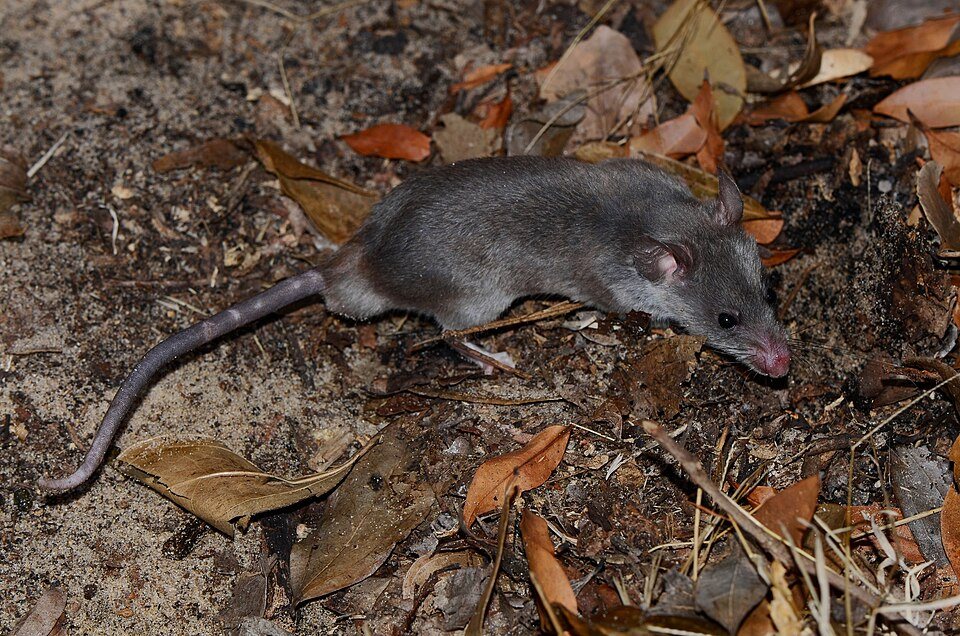
Photo: no rights reserved · CC0
Beamys hindei
Conservation status: Unknown
Basic stats
Habitat
Coastal forests and woodlands below 400m (up to 1,200m in the Usambara Mountains), often on sandy soils
Range
Kenya and Tanzania
Litter size
2–8 young (GBIF)
Gestation period
22–23 days in captivity
Size
Head and body 125–155mm, tail 114–127mm
Weight
49–76g
Hinde's long-tailed pouched rat, also called the lesser hamster-rat, is a rodent in the family Nesomyidae, named by Oldfield Thomas after Sidney Langford Hinde, a British officer and recreational naturalist. It is medium-sized, with well-developed cheek pouches, soft grey fur on the back shading to pure white underneath, and white on the chin, throat and upper chest. Its ears are relatively large and its tail can grip and is marked with obvious white. Its short limbs are white, with four digits on the forefeet and five on the hindfeet. Males are on average larger than females, though measurements overlap. Head and body measure 125–155mm, tail 114–127mm, and weight 49–76g (GBIF description, Nesomyidae; Wikipedia, general species account).
It is found in Kenya and Tanzania, in subtropical or tropical moist lowland coastal forest. GBIF describes coastal forests and woodlands below 400m, rising to about 1,200m in the Usambara Mountains, typically on sandy soils, and it also enters fallow fields and cassava plantations. Home ranges of adult males are larger than those of females, and densities in good habitat are around 14–31 individuals per hectare. Breeding appears aseasonal, with more lactating females during the rains, and captive gestation lasts 22–23 days with 2–8 young per litter. Habitat loss is noted as a threat (Wikipedia, general species account; GBIF description, Nesomyidae).
Quick answers
- What habitat does the Hinde's Long-tailed Pouched Rat live in?
- Coastal forests and woodlands below 400m (up to 1,200m in the Usambara Mountains), often on sandy soils
- Where is the Hinde's Long-tailed Pouched Rat found?
- Kenya and Tanzania
- What is the litter size of the Hinde's Long-tailed Pouched Rat?
- 2–8 young (GBIF)
- How long is the gestation period of the Hinde's Long-tailed Pouched Rat?
- 22–23 days in captivity
- How big is the Hinde's Long-tailed Pouched Rat?
- Head and body 125–155mm, tail 114–127mm
- How much does the Hinde's Long-tailed Pouched Rat weigh?
- 49–76g