
 Wildlife
of Kenya
Hildegarde's Broad-headed Mouse
Rodents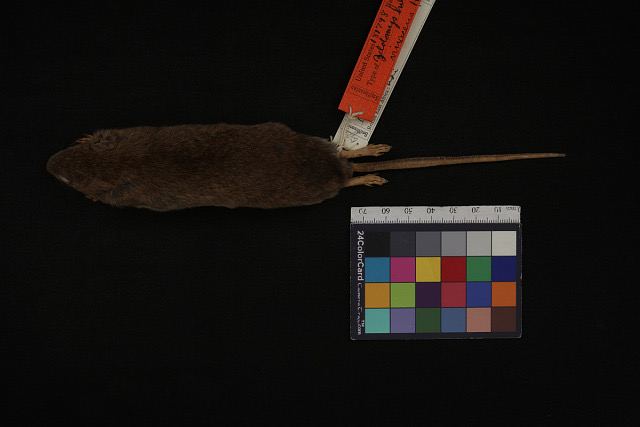
Photo: Katie Sayers · CC0
Zelotomys hildegardeae
Conservation status: Unknown
Basic stats
Diet
Mainly arthropods such as grasshoppers, crickets and dung beetles, with some fruit
Habitat
Moist savanna, tall grassland and scrub, often at swamp or forest edges
Range
Central Africa, from Angola and Zambia east to Tanzania and north to South Sudan
Litter size
3–7 young
Weight
38–74g
Hildegarde's broad-headed mouse, Zelotomys hildegardeae, is a rodent in the family Muridae, also called Hildegarde's zelotomys. It has a broad head, pale grey to white cheeks, and a whitish chin and throat. Its soft, dense fur is greyish brown or grey above and whitish or pale greyish brown below, with the two colours merging on the flanks. The ears are dark and nearly hairless, and the tail, about 70% of head-body length, has rings of small scales and sparse short hairs. Head and body measure 100–122mm and weight is 38–74g. It gives off a strong, unpleasant odour that may deter predators (Wikipedia, general species account; GBIF description, Muridae).
It is endemic to tropical Central Africa, ranging from Angola, northern Zambia and southern DR Congo east to Tanzania, and north to Uganda, Kenya and South Sudan. It lives in moist savanna, tall grassland and scrub, often at swamp or forest edges, and sometimes in pine plantations near homes in northern Malawi. It is partly diurnal and nocturnal and forages on the ground under long grass for grasshoppers, crickets, dung beetles and other insects and myriapods, with some fruit. Litters usually have three to seven young (Wikipedia, general species account; GBIF description, Muridae).
Quick answers
- What does the Hildegarde's Broad-headed Mouse eat?
- Mainly arthropods such as grasshoppers, crickets and dung beetles, with some fruit
- What habitat does the Hildegarde's Broad-headed Mouse live in?
- Moist savanna, tall grassland and scrub, often at swamp or forest edges
- Where is the Hildegarde's Broad-headed Mouse found?
- Central Africa, from Angola and Zambia east to Tanzania and north to South Sudan
- What is the litter size of the Hildegarde's Broad-headed Mouse?
- 3–7 young
- How much does the Hildegarde's Broad-headed Mouse weigh?
- 38–74g