
 Wildlife
of Kenya
Eastern Paradise-Whydah
Weavers, Waxbills & Whydahs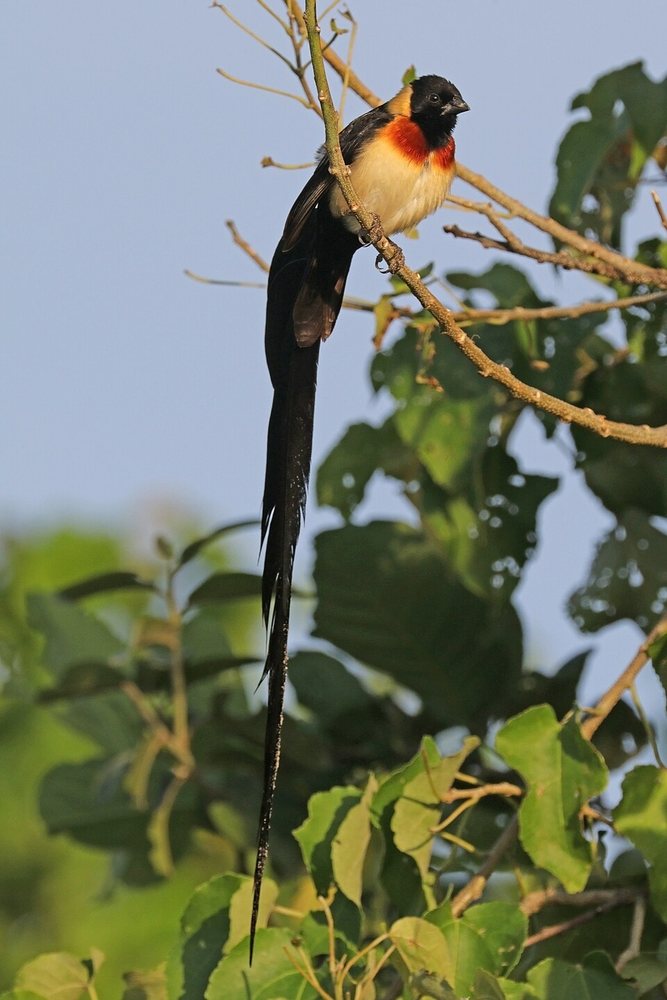
Photo: Charles J. Sharp · CC BY-SA 4.0 (May be cropped or resized)
Vidua paradisaea
Conservation status: Unknown
Eastern Paradise-Whydah spans eastern and southern Africa, reaching from Ethiopia to South Africa and westward to Angola. It feeds mainly on seeds that have ripened and fallen to the ground. Outside the breeding season, males and females are difficult to tell apart; breeding males molt into a striking form with a greatly elongated tail, which may exceed three times the body length. The long streamers and bright plumage make displaying males conspicuous in open country. (Wikipedia, general species account; Collins Birds of the World; AVONET, Tobias et al. 2022; EltonTraits, Wilman et al. 2014)
Breeding males have a black head and back, rusty breast, buff-yellow nape and white belly, followed by long black tail feathers that may reach 36 cm. Females are shorter-tailed and have brownish, streaked plumage. The species is a brood parasite: females lay eggs in another bird’s nest without removing the host’s eggs. Males mimic songs, and females may use these vocal performances when choosing a mate. Together, the tail and song are central to courtship. (Wikipedia, general species account; Collins Birds of the World; AVONET, Tobias et al. 2022; EltonTraits, Wilman et al. 2014)
Where to see Eastern Paradise-Whydah in Kenya
GBIF records grouped by protected area. They show where the species has been reported, not that it is there now, and they are not population counts.
Recorded in 36 protected areas (1909–2026). The 8 with the most records:
- Tsavo West National Park: 518 records (1969–2025)
- Tsavo East National Park: 364 records (1969–2026)
- Ndara Conservancy: 77 records (1995–2024)
- Samburu National Reserve: 63 records (1984–2024)
- Meru National Park: 47 records (1969–2024)
- Buffalo Springs National Reserve: 39 records (1984–2024)
- Amboseli National Park: 33 records (1989–2024)
- Ngutuni Conservancy: 32 records (2003–2024)