
 Wildlife
of Kenya
Eastern Greenish Yellow Bat
Bats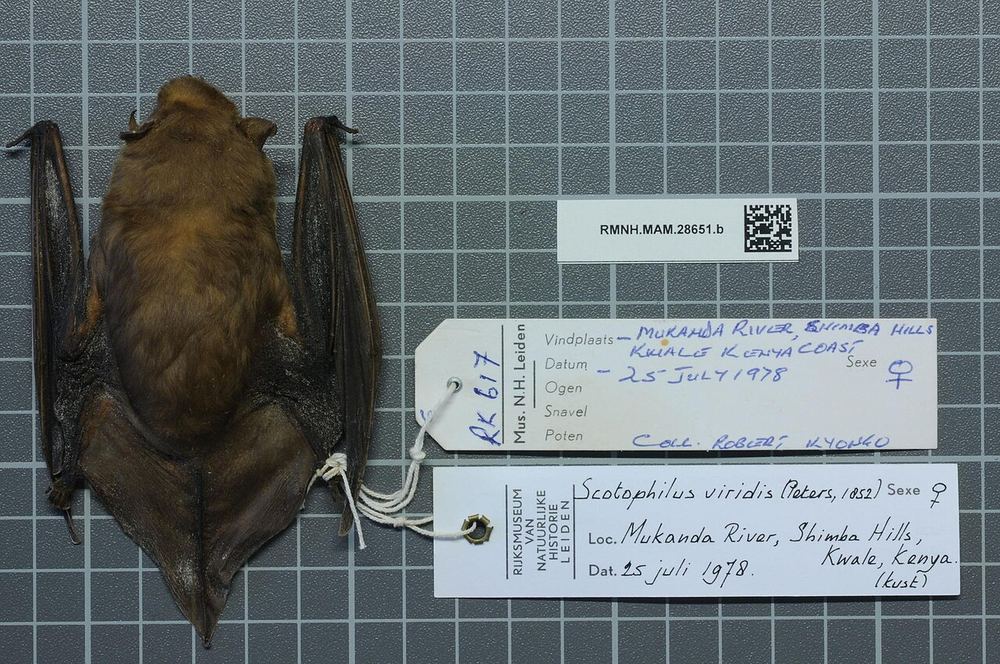
Photo: Wikimedia Commons contributor · CC0
Scotophilus viridis
Conservation status: Unknown
Basic stats
Habitat
Miombo woodland and dry or moist savanna, often near streams
Range
Eastern and southern Africa
Litter size
Two
Size
Forearm 41–51mm
The eastern greenish yellow bat, Scotophilus viridis, was first described by W. C. H. Peters in 1851. Its head and body measure 71–82mm, its tail 34–49mm and its forearm 41–51mm, although these measurements may include the western species. The soft, sleek fur is greenish brown to medium brown on the back, with paler bases, while the underside is pale to medium yellow or whitish. The ears are short, separated and dark brown. The western greenish yellow bat, S. nigritellus, of western Africa was once considered the same species (Wikipedia, general species account; GBIF description, Vespertilionidae).
It is recorded across eastern and southern Africa, reaching north to Ethiopia and south to South Africa. Its habitats include dry and moist savanna, coastal forest in Tanzania, and miombo woodland mostly near streams in Malawi. In Kruger National Park, mating and fertilisation happen in autumn, the embryo pauses at an early stage for six to eight weeks, and young are born in November. Litters are two, and flying young are recorded from October to January (Wikipedia, general species account; GBIF description, Vespertilionidae).
Quick answers
- What habitat does the Eastern Greenish Yellow Bat live in?
- Miombo woodland and dry or moist savanna, often near streams
- Where is the Eastern Greenish Yellow Bat found?
- Eastern and southern Africa
- What is the litter size of the Eastern Greenish Yellow Bat?
- Two
- How big is the Eastern Greenish Yellow Bat?
- Forearm 41–51mm