
 Wildlife
of Kenya
Crowned Lapwing
Plovers, Sandpipers & Other Waders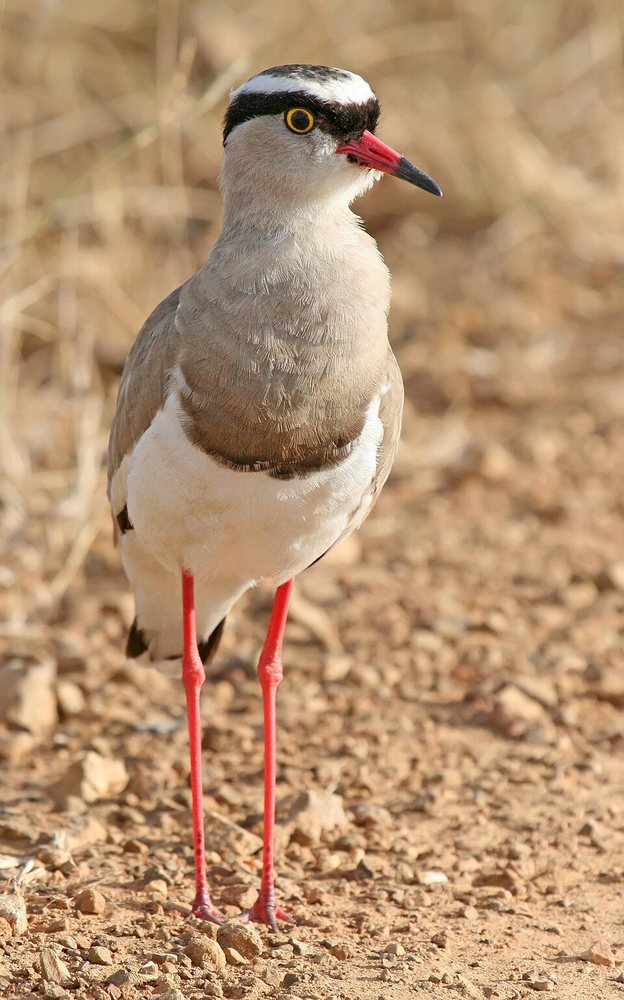
Photo: Muhammad Mahdi Karim Facebook The making of this document was supported by Wikimedia CH. (Submit your project!) For all the files concerned, please see the category Supported by Wikimedia CH. العربية ∙ বাংলা ∙ čeština ∙ Deutsch ∙ English ∙ Esperanto ∙ español ∙ français ∙ galego ∙ हिन्दी ∙ magyar ∙ italiano ∙ 日本語 ∙ македонски ∙ Nederlands ∙ português do Brasil ∙ rumantsch ∙ русский ∙ sicilianu ∙ slovenščina ∙ தமிழ் ∙ українська ∙ 中文 ∙ +/− · GFDL 1.2 (May be cropped or resized)
Vanellus coronatus
Conservation status: Unknown
Basic stats
Habitat
Short, dry grassland, including burnt or grazed areas
Range
Red Sea coast of Somalia to southern and southwestern Africa
Size
30cm
Weight
About 165g
Crowned Lapwing, also called Crowned Plover or Kiewiet, extends from Somalia’s Red Sea shore southward through eastern Africa to the continent’s southern and southwestern regions. Its head is boldly patterned: a black crown is encircled by a white ring, set against brown and white plumage. Adults are conspicuous and vocal. Males average about three percent larger than females; juveniles are duller, with yellowish legs and a bill lacking the adults’ red base. (Wikipedia, general species account; Collins Birds of the World; AVONET, Tobias et al. 2022)
This lapwing prefers short, dry grassland, including grazed or burnt ground, and avoids mountains. In wetter parts of Zambia and Zimbabwe it is mainly a dry-season visitor, while rainfall can draw birds to northern Botswana. It feeds by pecking at the surface for insects, particularly termites and ants, often taking them from mammal dung. Males defend nesting territories with displays; pairs may stay together for life, and females do most incubation. (Wikipedia, general species account)
Where to see Crowned Lapwing in Kenya
GBIF records grouped by protected area. They show where the species has been reported, not that it is there now, and they are not population counts.
Recorded in 133 protected areas (1930–2026). The 8 with the most records:
- Masai Mara: 4,149 records (1973–2026)
- Nairobi National Park: 1,838 records (1970–2025)
- Mara Triangle: 1,154 records (1976–2026)
- Lake Nakuru National Park: 987 records (1969–2024)
- Buffalo Springs National Reserve: 792 records (1969–2026)
- Mpala Ranch: 712 records (1996–2026)
- Ol Pejeta Conservancy: 704 records (1989–2026)
- Amboseli National Park: 537 records (1975–2026)
Quick answers
- What habitat does the Crowned Lapwing live in?
- Short, dry grassland, including burnt or grazed areas
- Where is the Crowned Lapwing found?
- Red Sea coast of Somalia to southern and southwestern Africa
- How big is the Crowned Lapwing?
- 30cm
- How much does the Crowned Lapwing weigh?
- About 165g