
 Wildlife
of Kenya
Common Hippopotamus
Hippos, Pigs & Chevrotains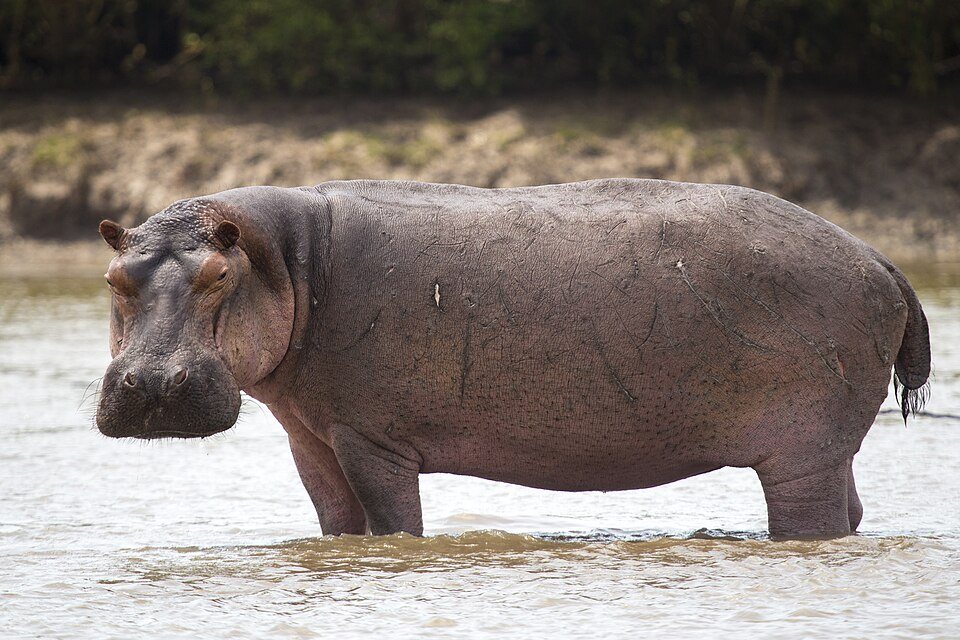
Photo: Muhammad Mahdi Karim · CC BY-SA 4.0 (May be cropped or resized)
Hippopotamus amphibius
Conservation status: Unknown
Basic stats
Diet
Mostly short grasses
Habitat
Rivers, lakes and wetlands beside grazing areas
Litter size
Usually 1 calf
Gestation period
About 8 months
Weight
Adult males commonly 1.5–1.8 tonnes
The common hippopotamus is a massive, barrel-bodied mammal with short legs, a huge head and eyes, ears and nostrils set high on the skull. Grey to purplish skin secretes an oily reddish fluid that helps protect it from sun and microbes. Despite its bulk it moves quickly on land and does not truly swim, instead pushing from the bottom (Wikipedia, general species account; COMBINE, Soria et al. 2021).
Hippos spend daylight resting in water in groups and leave mainly after dark to graze. Territorial males defend stretches of water, displaying with an enormous gape, while animals usually feed alone on land. In Kenya they are conspicuous in the Mara River, Lake Naivasha and Mzima Springs in Tsavo West. They can be dangerous at close range. The guide records Kenya national status as unknown.
Where to see Common Hippopotamus in Kenya
GBIF records grouped by protected area. They show where the species has been reported, not that it is there now, and they are not population counts.
Recorded in 13 protected areas (1929–2026). The 8 with the most records:
- Masai Mara: 32 records (1989–2023)
- Lake Nakuru National Park: 28 records (1929–2017)
- Amboseli National Park: 20 records (1989–2026)
- Nairobi National Park: 7 records (1987–2026)
- Mara North Conservancy: 7 records (2010–2022)
- Meru National Park: 5 records (2022–2025)
- Mara Triangle: 5 records (2013–2023)
- Tsavo West National Park: 4 records (2011–2016)
Quick answers
- What does the Common Hippopotamus eat?
- Mostly short grasses
- What habitat does the Common Hippopotamus live in?
- Rivers, lakes and wetlands beside grazing areas
- What is the litter size of the Common Hippopotamus?
- Usually 1 calf
- How long is the gestation period of the Common Hippopotamus?
- About 8 months
- How much does the Common Hippopotamus weigh?
- Adult males commonly 1.5–1.8 tonnes