
 Wildlife
of Kenya
Blue-capped Cordonbleu
Weavers, Waxbills & Whydahs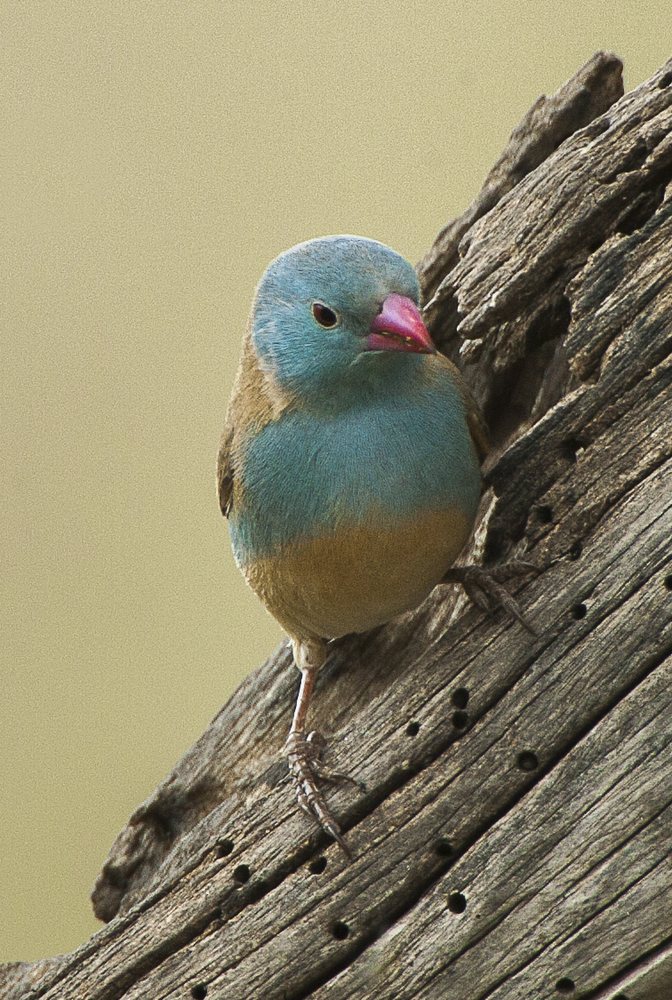
Photo: Francesco Veronesi from Italy · CC BY-SA 2.0 (May be cropped or resized)
Uraeginthus cyanocephalus
Conservation status: Unknown
Basic stats
Habitat
Dry grassland, scrub and desert
Range
East Africa, from Ethiopia to Tanzania
Weight
About 10g
Blue-capped Cordonbleu occurs in East Africa, across Ethiopia, Kenya, Somalia, South Sudan and Tanzania. It inhabits lowland dry grassland, shrubland and desert in sub-Saharan Africa. AVONET gives an average mass of about 10 g, while EltonTraits indicates a seed-heavy diet and ground-level feeding. Males show a blue crown and are more vivid overall; females have brown wings that continue up the nape and over the head. (Wikipedia, general species account; AVONET, Tobias et al. 2022; EltonTraits, Wilman et al. 2014)
This small finch eats seeds and small insects and is quieter than many other finches. During pair displays, both birds carry twigs in their bills as they dance. High-speed filming has captured partners tapping their feet twenty-five to fifty times each second, producing a buzz. The species can be kept in captivity when conditions are suitable, though breeding it is described as difficult. (Wikipedia, general species account)
Where to see Blue-capped Cordonbleu in Kenya
GBIF records grouped by protected area. They show where the species has been reported, not that it is there now, and they are not population counts.
Recorded in 47 protected areas (1963–2026). The 8 with the most records:
- Tsavo West National Park: 317 records (1977–2024)
- Samburu National Reserve: 243 records (1973–2026)
- Tsavo East National Park: 117 records (1963–2024)
- Ndara Conservancy: 85 records (1995–2022)
- Buffalo Springs National Reserve: 72 records (1983–2024)
- Amboseli National Park: 58 records (1996–2024)
- Ol Kelunyiet Conservancy: 47 records (2014–2025)
- Shaba National Reserve: 46 records (2001–2024)
Quick answers
- What habitat does the Blue-capped Cordonbleu live in?
- Dry grassland, scrub and desert
- Where is the Blue-capped Cordonbleu found?
- East Africa, from Ethiopia to Tanzania
- How much does the Blue-capped Cordonbleu weigh?
- About 10g