
 Wildlife
of Kenya
Yellow-winged False-vampire
Bats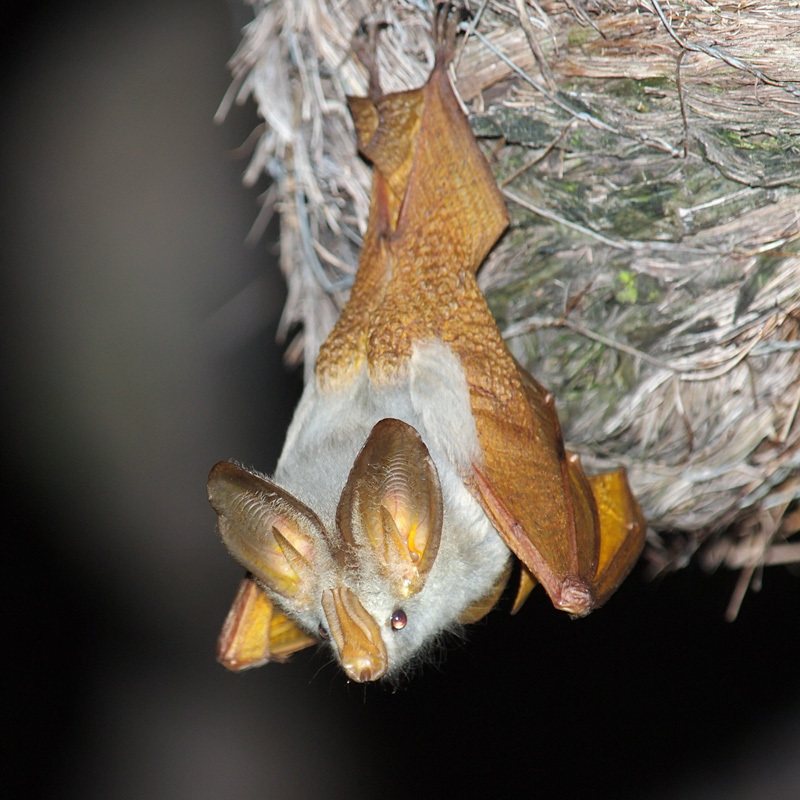
Photo: (c) Oleg Chernyshov, some rights reserved (CC BY), uploaded by Oleg Chernyshov · CC-BY (May be cropped or resized)
Lavia frons
Conservation status: Unknown
Basic stats
Diet
Insects only, such as termites and scarab beetles
Habitat
Woodland and savannah, often near water
Range
Sub-Saharan Africa south to northern Zambia
Size
Total length 58–80mm
Weight
28–36g
The yellow-winged bat is one of five false vampire bats from Africa and the only species in its genus, Lavia. It measures 58–80mm in total length and weighs 28–36g, with females slightly larger than males. Its wingspan averages 36cm. Its long fur is pearl grey to slaty grey, sometimes with greenish-yellow on the hindparts and underside in males, while the wings, noseleaf and ears are reddish-yellow. It has no external tail, and males have a glandular area on the lower back that releases a yellow substance (Wikipedia, general species account).
It ranges widely across sub-Saharan Africa south to northern Zambia, living mainly in woodland and savannah below 2,000m. It prefers acacia trees and thorn bushes near water, where the spacing of vegetation lets it see its surroundings. Roosting takes place in small trees, shrubs, tree cavities and buildings, with a primary and a peripheral roost tree that it switches between, especially on hot days. The species eats only insects, both soft- and hard-bodied, including termites, scarab beetles and moths, and it waits on a perch before striking. Males and females form monogamous pairs in the breeding season (Wikipedia, general species account).
Where to see Yellow-winged False-vampire in Kenya
GBIF records grouped by protected area. They show where the species has been reported, not that it is there now, and they are not population counts.
Recorded in 5 protected areas (1965–2026).
- Kagamega Forest: 15 records (2014)
- Loldaiga Hills Conservancy: 11 records (2014)
- Buffalo Springs National Reserve: 4 records (1965–2013)
- Lake Bogoria National Reserve: 4 records (1968–2014)
- Masai Mara: 3 records (2023–2026)
Quick answers
- What does the Yellow-winged False-vampire eat?
- Insects only, such as termites and scarab beetles
- What habitat does the Yellow-winged False-vampire live in?
- Woodland and savannah, often near water
- Where is the Yellow-winged False-vampire found?
- Sub-Saharan Africa south to northern Zambia
- How big is the Yellow-winged False-vampire?
- Total length 58–80mm
- How much does the Yellow-winged False-vampire weigh?
- 28–36g