
 Wildlife
of Kenya
Unstriped Ground Squirrel
Rodents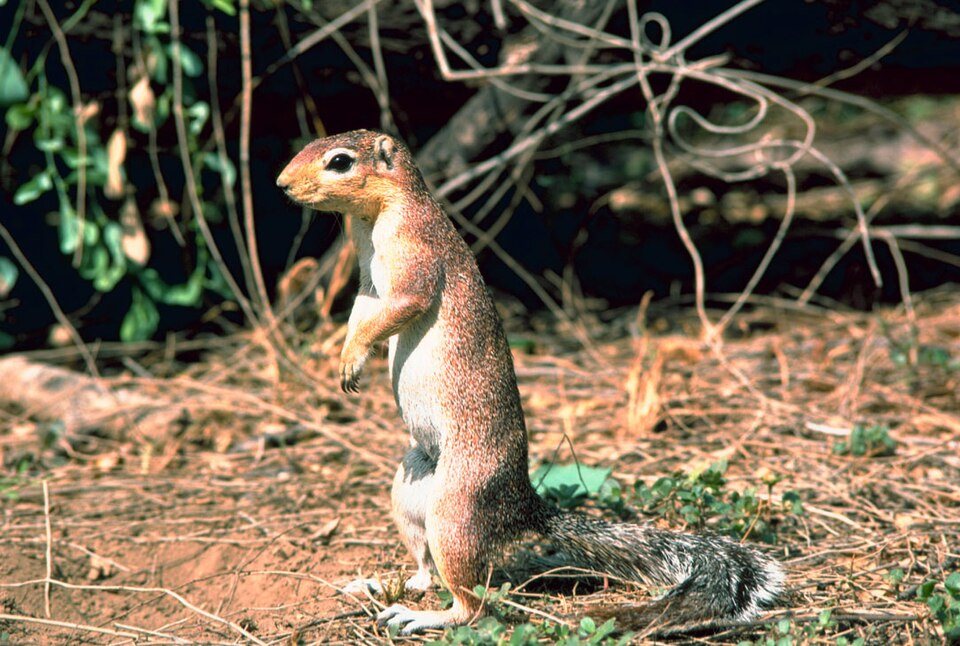
Photo: Gary M. Stolz · Public domain
Xerus rutilus
Conservation status: Unknown
Basic stats
Diet
Fruit (such as baobab), seeds (Acacia, Commiphora), leaves and flowers; some insects
Habitat
Dry savanna and scrub, open plains and gravel flats, from sea level to over 2,000m
Range
Sudan and Eritrea through Ethiopia, Djibouti, Somalia and Kenya to Uganda and Tanzania
Litter size
1–2 young
Size
Head and body 226–269mm; tail 182–203mm
Weight
252–369g
The unstriped ground squirrel is the African ground squirrel that lacks side stripes. Its coarse coat is pale tan to red-brown, paler in drier regions, and grizzled on the back and tail, with a buff-to-cream eye ring, paler feet and belly, and sparser belly hair than back hair. Head and body measure 226–269 mm, the tail 182–203 mm and weight is 252–369 g. Eight subspecies are recognised, some olive or brownish and others more reddish (GBIF description, Sciuridae). Other names include Pallid Ground Squirrel (GBIF vernacular names).
Diurnal, it emerges well after sunrise, basks and grooms before foraging, and relies on burrows, termite mounds and shade to regulate its temperature, limiting activity in high heat. Burrow systems have 2–6 entrances, often shaded by vegetation. In suitable habitat it forms loose colonies, within which family groups of up to six use one burrow system, sometimes shared with other species such as the striped ground squirrel. Males dominate females for access to food. Breeding occurs through the year, with litters of 1–2 young. It commonly occupies disturbed habitat and cultivated fields (GBIF description, Sciuridae).
Where to see Unstriped Ground Squirrel in Kenya
GBIF records grouped by protected area. They show where the species has been reported, not that it is there now, and they are not population counts.
Recorded in 7 protected areas (1913–2026).
- Samburu National Reserve: 19 records (1972–2026)
- Buffalo Springs National Reserve: 15 records (1972–2025)
- Tsavo West National Park: 14 records (1913–2024)
- Tsavo East National Park: 7 records (2003–2026)
- Kalama Community Conservancy: 5 records (2019–2024)
- Kapiti Plains Estate Conservancy: 3 records (2019)
- Mpala Ranch: 3 records (2015–2025)
Quick answers
- What does the Unstriped Ground Squirrel eat?
- Fruit (such as baobab), seeds (Acacia, Commiphora), leaves and flowers; some insects
- What habitat does the Unstriped Ground Squirrel live in?
- Dry savanna and scrub, open plains and gravel flats, from sea level to over 2,000m
- Where is the Unstriped Ground Squirrel found?
- Sudan and Eritrea through Ethiopia, Djibouti, Somalia and Kenya to Uganda and Tanzania
- What is the litter size of the Unstriped Ground Squirrel?
- 1–2 young
- How big is the Unstriped Ground Squirrel?
- Head and body 226–269mm; tail 182–203mm
- How much does the Unstriped Ground Squirrel weigh?
- 252–369g