
 Wildlife
of Kenya
Typical Striped Grass Mouse
Rodents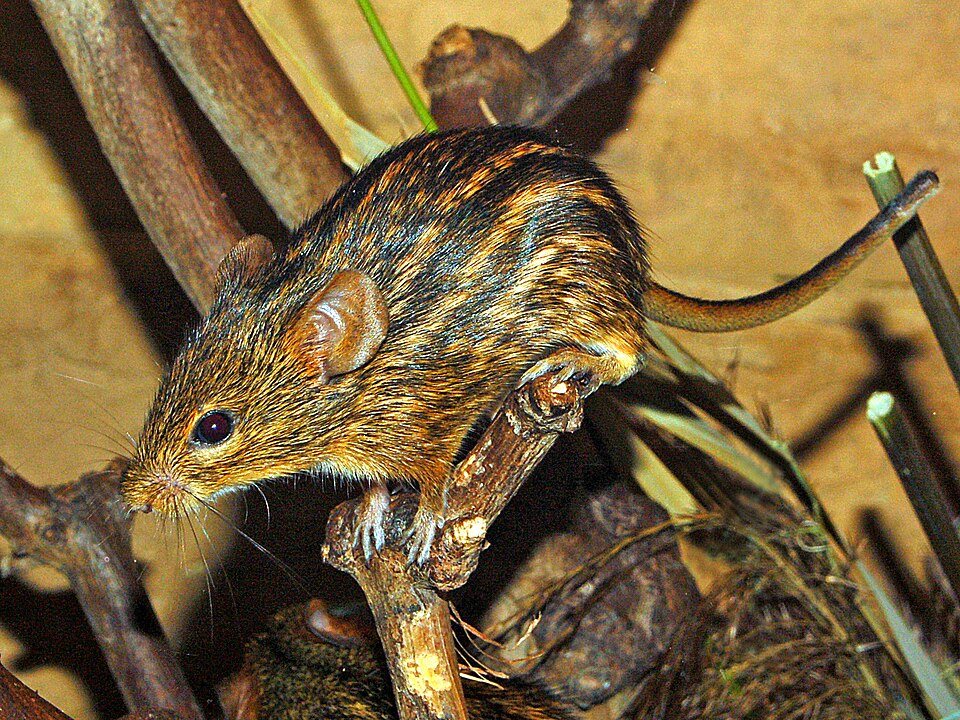
Photo: Hectonichus · CC BY-SA 3.0 (May be cropped or resized)
Lemniscomys striatus
Conservation status: Unknown
Basic stats
Habitat
Deforested land, grassland, secondary forest and savanna up to 1,700m
Range
Central and West Africa, from Guinea to Malawi
Litter size
Average 4.54
Gestation period
About 25 days
Size
Head and body 93–142mm, tail 92–155mm
Weight
Average adult 42.3g
The typical striped grass mouse is a small rodent in the suborder Myomorpha and the family Muridae. Its head and body measure 93–142mm, its tail 92–155mm, its hind foot 20.5–32mm and its ears 14–17.5mm, and it weighs up to 68g, averaging 42.3g as an adult (Wikipedia, general species account). Its back is blackish brown, with pale dorsal stripes running to the tail base and small pale spots along each side. The underside is whitish with yellowish tints on the belly and chest, and the tail is longer than the head and body. Females have two pairs of pectoral and two pairs of inguinal nipples, and the karyotype is 2n = 43–44 (Wikipedia, general species account).
It is native to Central and West Africa and occurs in Guinea, Sierra Leone, Ghana, Burkina Faso, Ethiopia, Angola, Kenya, Uganda, Rwanda, DRCongo, Tanzania, Zambia and Malawi (Wikipedia, general species account). It lives in deforested land, grassland, secondary forest and savanna up to 1,700m above sea level. Females reach sexual maturity at about 168 days, with a gestation of about 25 days and litters averaging 4.54 young (Wikipedia, general species account; AnAge). Wild individuals rarely survive much beyond their first breeding season, and the oldest recorded captive animal was 4.8 years old (AnAge).
Where to see Typical Striped Grass Mouse in Kenya
GBIF records grouped by protected area. They show where the species has been reported, not that it is there now, and they are not population counts.
Recorded in 3 protected areas (1961–2015).
- Mathew's Range Forest Reserve: 15 records (2005)
- Kagamega Forest: 6 records (1961–2015)
- Masai Mara: 2 records (1963)
Quick answers
- What habitat does the Typical Striped Grass Mouse live in?
- Deforested land, grassland, secondary forest and savanna up to 1,700m
- Where is the Typical Striped Grass Mouse found?
- Central and West Africa, from Guinea to Malawi
- What is the litter size of the Typical Striped Grass Mouse?
- Average 4.54
- How long is the gestation period of the Typical Striped Grass Mouse?
- About 25 days
- How big is the Typical Striped Grass Mouse?
- Head and body 93–142mm, tail 92–155mm
- How much does the Typical Striped Grass Mouse weigh?
- Average adult 42.3g