
 Wildlife
of Kenya
Trumpeter Hornbill
Hornbills & Hoopoes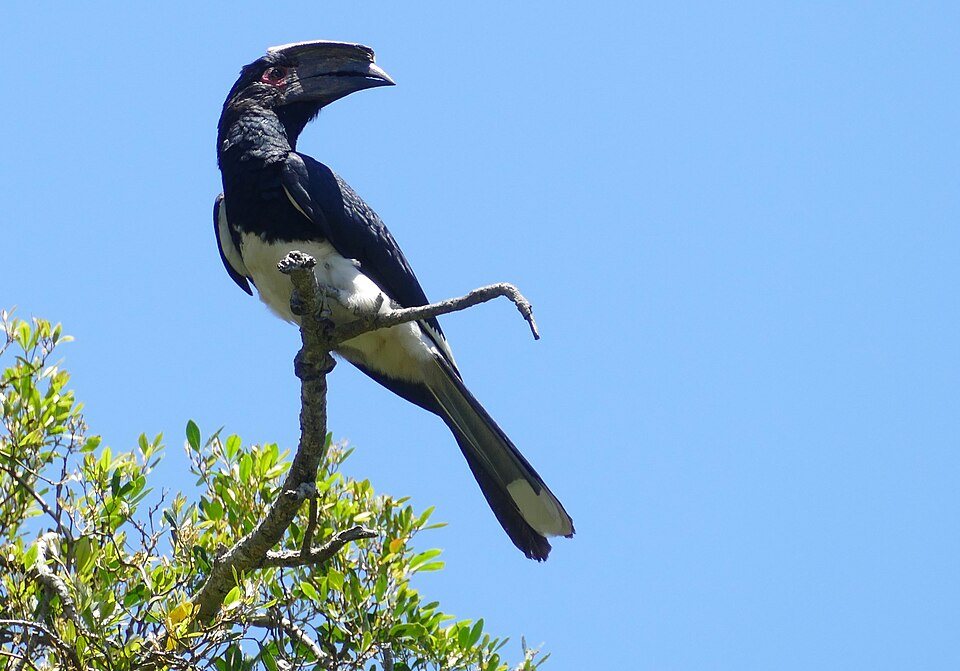
Photo: Bernard DUPONT from FRANCE · CC BY-SA 2.0 (May be cropped or resized)
Bycanistes bucinator
Conservation status: Unknown
The Trumpeter Hornbill is a medium-sized hornbill with a large grey casque, a dark back, white belly and white underwing coverts. Red facial skin is distinctive, and the female has a smaller casque. Adults measure about 58–65 cm, with a mass range of roughly 0.45–1 kg. The AVONET mean mass is about 639 g and mean wing length about 278 mm (Wikipedia, general species account; AVONET, Tobias et al. 2022).
This resident forest bird occurs in eastern and southern Africa, where it uses tropical evergreen forest and associated wooded habitats. Fruit supplies most of its EltonTraits diet profile, with smaller shares from invertebrates and vertebrate prey. It is gregarious, usually living in pairs or small groups but sometimes gathering in much larger numbers. Like other hornbills, the female incubates inside a sealed nest cavity (Wikipedia, general species account; EltonTraits, Wilman et al. 2014).
Where to see Trumpeter Hornbill in Kenya
GBIF records grouped by protected area. They show where the species has been reported, not that it is there now, and they are not population counts.
Recorded in 12 protected areas (1968–2024). The 8 with the most records:
- Arabuko-Sokoke Forest Reserve: 673 records (1968–2024)
- Shimba Hills National Reserve: 186 records (1970–2024)
- Watamu Marine National Park: 107 records (1973–2024)
- Meru National Park: 60 records (1969–2024)
- Tana Delta Community Conservancy: 20 records (1973–2024)
- Kibzezi Forest: 17 records (1985–2024)
- Tsavo West National Park: 12 records (1991–2024)
- Ndera Community Conservancy: 6 records (1975–2021)