
 Wildlife
of Kenya
Striped Ground Squirrel
Rodents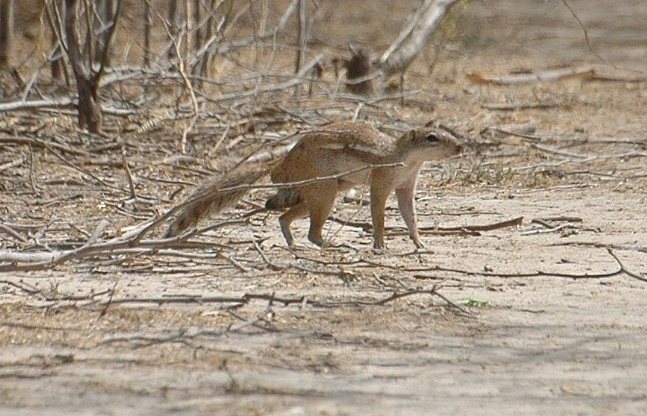
Photo: BOISSEL Philippe · Public domain
Euxerus erythropus
Conservation status: Unknown
Basic stats
Diet
Seeds, nuts and roots, occasionally eggs and insects
Habitat
Open or disturbed forest and savannah, often near cultivated land; semi-arid terrain
Range
Sub-Saharan Africa north of the rainforest, from the Atlantic coast to Ethiopia and Kenya
Litter size
About 3.5 young
Gestation period
About 71 days
Size
Length 22–29cm, tail 19–26cm
Weight
0.5–1kg
The striped ground squirrel is a moderately large ground squirrel first described by Geoffroy in 1803, and it has six recognised subspecies. Its coat is sandy-brown to dark-brown with a pure white stripe down each flank, and its underparts are whitish and almost hairless. Its tail hairs are long and multi-coloured, giving a grizzled look, and the small ears and long muzzle complete its profile. The limbs are pale with large feet and long, straight claws. Females have three pairs of teats, unlike the similar Cape and mountain ground squirrels (Wikipedia, general species account).
It is found in Africa south of the Sahara and north of the tropical rainforest, from the Atlantic coast in the west to Ethiopia and Kenya in the east, and it is absent from the Horn of Africa. It is diurnal and mostly terrestrial, though it climbs into bushes for food. It eats seeds, nuts and roots, sometimes eggs and small animals, and can be an agricultural pest of cassava, yams and peanuts. Home ranges are about 12ha and overlap widely. Adults live alone or in pairs in a simple burrow with a central nest, and they cache surplus food under stones. Gestation is about 71 days and litters average around 3.5 young (Wikipedia, general species account; AnAge).
Quick answers
- What does the Striped Ground Squirrel eat?
- Seeds, nuts and roots, occasionally eggs and insects
- What habitat does the Striped Ground Squirrel live in?
- Open or disturbed forest and savannah, often near cultivated land; semi-arid terrain
- Where is the Striped Ground Squirrel found?
- Sub-Saharan Africa north of the rainforest, from the Atlantic coast to Ethiopia and Kenya
- What is the litter size of the Striped Ground Squirrel?
- About 3.5 young
- How long is the gestation period of the Striped Ground Squirrel?
- About 71 days
- How big is the Striped Ground Squirrel?
- Length 22–29cm, tail 19–26cm
- How much does the Striped Ground Squirrel weigh?
- 0.5–1kg