
 Wildlife
of Kenya
Steel-blue Whydah
Weavers, Waxbills & Whydahs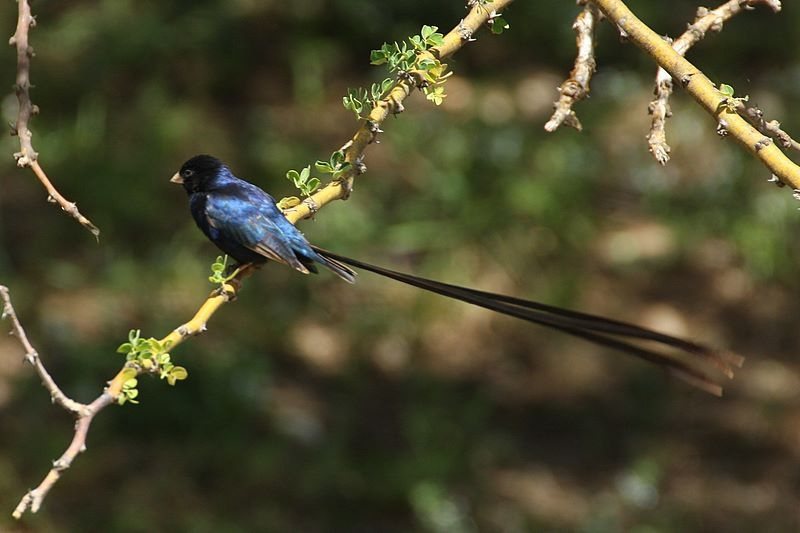
Photo: (c) Demetrius John Kessy, some rights reserved (CC BY) · CC-BY (May be cropped or resized)
Vidua hypocherina
Conservation status: Unknown
Steel-blue Whydah occurs from Ethiopia and Somalia south toward Tanzania, across dry and somewhat bushy landscapes. The sexes differ markedly in size and appearance: breeding males reach about 30 cm because of their elongated tail, while females measure around 10 cm. The male is mostly black with a long tail, whereas the female has dark markings and a much shorter tail. This contrast makes the breeding male unmistakable in the field. (Wikipedia, general species account; Collins Birds of the World; AVONET, Tobias et al. 2022; EltonTraits, Wilman et al. 2014)
The species is a brood parasite whose main host is the Black-faced Waxbill. Males sing varied short phrases, mixing chatter with twittering or plaintive whistles, and song is part of the display behavior associated with reproduction. Its range overlaps dry bush country used by its host. These links among habitat, display and parasitism help explain the whydah’s natural history, while its compact female form differs sharply from the long-tailed male. (Wikipedia, general species account; Collins Birds of the World; AVONET, Tobias et al. 2022; EltonTraits, Wilman et al. 2014)
Where to see Steel-blue Whydah in Kenya
GBIF records grouped by protected area. They show where the species has been reported, not that it is there now, and they are not population counts.
Recorded in 30 protected areas (1973–2024). The 8 with the most records:
- Samburu National Reserve: 81 records (1973–2024)
- Buffalo Springs National Reserve: 50 records (1982–2024)
- Tsavo West National Park: 34 records (1983–2024)
- Shaba National Reserve: 34 records (2001–2024)
- Ndara Conservancy: 21 records (2012–2022)
- Sera Community Conservancy: 18 records (2017–2024)
- Tsavo East National Park: 15 records (1987–2024)
- West Gate Community Conservancy: 15 records (2019–2023)