
 Wildlife
of Kenya
Spotted Thick-knee
Plovers, Sandpipers & Other Waders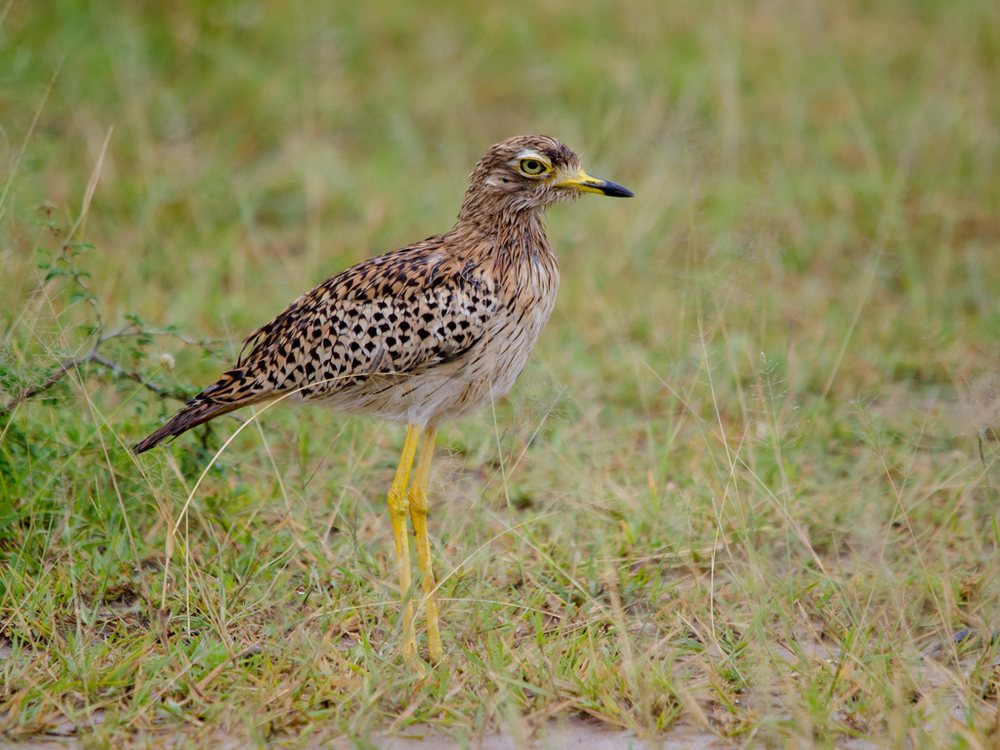
Photo: (c) William Stephens, some rights reserved (CC BY), uploaded by William Stephens · CC-BY (May be cropped or resized)
Burhinus capensis
Conservation status: Unknown
Basic stats
Diet
Invertebrates and small prey
Habitat
Grassland and savanna
Range
Central and southern Africa
Size
Up to 45.5cm high
Weight
About 423g
Known also as the Cape Thick-knee or Spotted Dikkop, this terrestrial wader inhabits central and southern Africa. Its long legs and brown-and-white speckled plumage blend with grassland and savanna surroundings. Its speckled pattern breaks up the body outline against grass and dry ground. Long legs support its terrestrial way of life in open country. AVONET gives a mean mass near 423 g. (Wikipedia, general species account; AVONET, Tobias et al. 2022)
It has a large rounded head and conspicuous eyes, and remains difficult to see when resting among vegetation. The species forages on the ground for invertebrates and other small prey, relying on its mottled pattern for concealment. The bird is a ground forager, searching for invertebrates and small prey. Its spotted plumage provides camouflage while it remains still among vegetation. Estimated diet shares are 80 percent invertebrates, 10 percent other invertebrates, and 10 percent seeds. (Wikipedia, general species account; AVONET, Tobias et al. 2022)
Where to see Spotted Thick-knee in Kenya
GBIF records grouped by protected area. They show where the species has been reported, not that it is there now, and they are not population counts.
Recorded in 68 protected areas (1969–2026). The 8 with the most records:
- Nairobi National Park: 897 records (1973–2026)
- Masai Mara: 319 records (1979–2025)
- Mpala Ranch: 160 records (2005–2024)
- Samburu National Reserve: 130 records (1977–2024)
- Buffalo Springs National Reserve: 125 records (1969–2024)
- Mara Triangle: 102 records (1979–2024)
- Tsavo West National Park: 81 records (1969–2024)
- Tsavo East National Park: 78 records (1969–2024)
Quick answers
- What does the Spotted Thick-knee eat?
- Invertebrates and small prey
- What habitat does the Spotted Thick-knee live in?
- Grassland and savanna
- Where is the Spotted Thick-knee found?
- Central and southern Africa
- How big is the Spotted Thick-knee?
- Up to 45.5cm high
- How much does the Spotted Thick-knee weigh?
- About 423g