
 Wildlife
of Kenya
Peregrine Falcon
Raptors & Vultures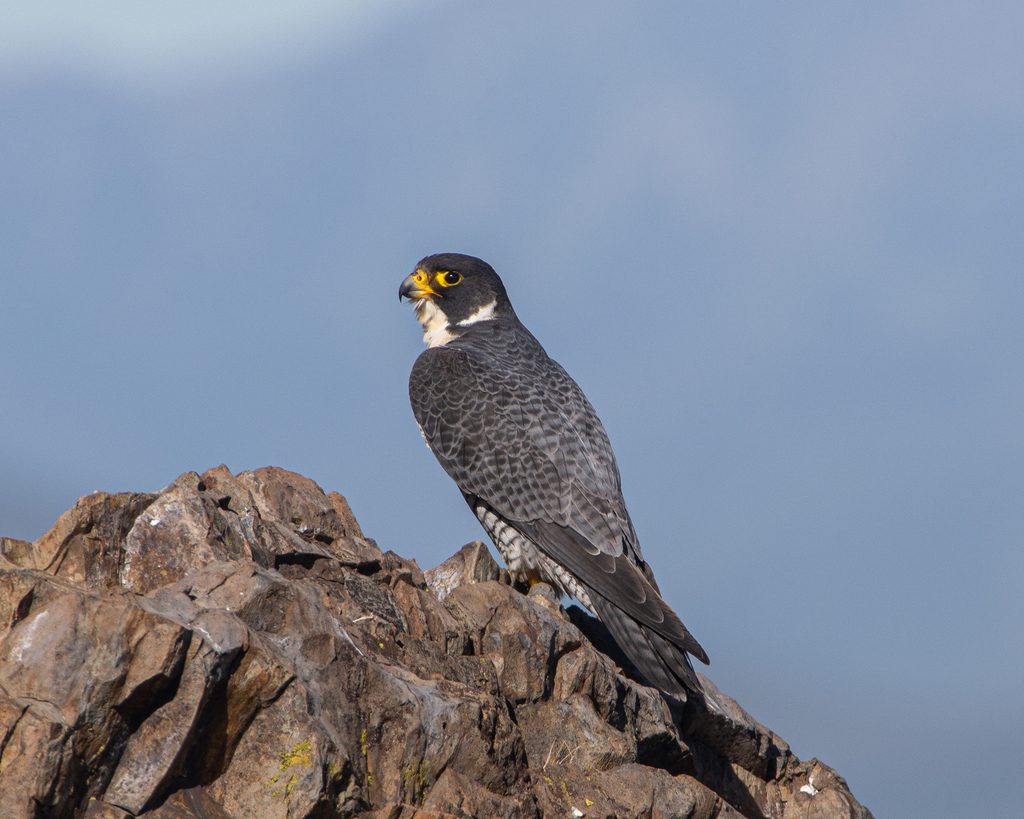
Photo: Nicolás Villaseca Merino · CC BY-SA 4.0 (May be cropped or resized)
Falco peregrinus
Conservation status: Unknown
Basic stats
Diet
Mostly medium-sized birds, with occasional small mammals, reptiles and insects
Habitat
Open landscapes, cliffs and cities with elevated nest sites
Range
Nearly worldwide from Arctic tundra to the tropics, absent from extreme polar regions and most tropical rainforest
Clutch size
Usually 3 eggs
Incubation period
About 30 days
Size
34–58cm
Wingspan
74–120cm
Weight
Averages about 760g
The Peregrine Falcon occurs across an exceptionally broad belt from Arctic tundra to tropical latitudes, although it is absent from extreme polar country and most tropical rainforest. Adults show blue-grey upperparts, barred pale underparts, a dark head and a strong black facial stripe. Females have the same general markings but are substantially larger than males. Many northern populations migrate, while cliffs and tall buildings provide elevated nesting ledges across much of the species’ range. (Wikipedia, general species account)
A specialist aerial hunter, the species feeds chiefly on medium-sized birds, though small mammals, reptiles and insects are sometimes taken. It commonly nests in a shallow scrape on a cliff ledge or a tall human-made structure, and urban birds often exploit abundant pigeons and ducks. AnAge reports a typical clutch of three and incubation of about 30 days, while AVONET gives mean mass as about 760 g. (Wikipedia, general species account; AnAge; AVONET, Tobias et al. 2022)
Where to see Peregrine Falcon in Kenya
GBIF records grouped by protected area. They show where the species has been reported, not that it is there now, and they are not population counts.
Recorded in 32 protected areas (1969–2024). The 8 with the most records:
- Amboseli National Park: 97 records (1986–2024)
- Tsavo West National Park: 74 records (1969–2023)
- Buffalo Springs National Reserve: 43 records (1985–2024)
- Tsavo East National Park: 41 records (1982–2023)
- Samburu National Reserve: 31 records (1987–2024)
- Lake Nakuru National Park: 27 records (1969–2023)
- Nairobi National Park: 23 records (1970–2024)
- Mount Kenya National Park: 22 records (1998–2024)
Quick answers
- What does the Peregrine Falcon eat?
- Mostly medium-sized birds, with occasional small mammals, reptiles and insects
- What habitat does the Peregrine Falcon live in?
- Open landscapes, cliffs and cities with elevated nest sites
- Where is the Peregrine Falcon found?
- Nearly worldwide from Arctic tundra to the tropics, absent from extreme polar regions and most tropical rainforest
- How many eggs does the Peregrine Falcon lay?
- Usually 3 eggs
- How long are the eggs of the Peregrine Falcon incubated?
- About 30 days
- How big is the Peregrine Falcon?
- 34–58cm
- What is the wingspan of the Peregrine Falcon?
- 74–120cm
- How much does the Peregrine Falcon weigh?
- Averages about 760g