
 Wildlife
of Kenya
Olive Bee-eater
Bee-eaters, Rollers & Kingfishers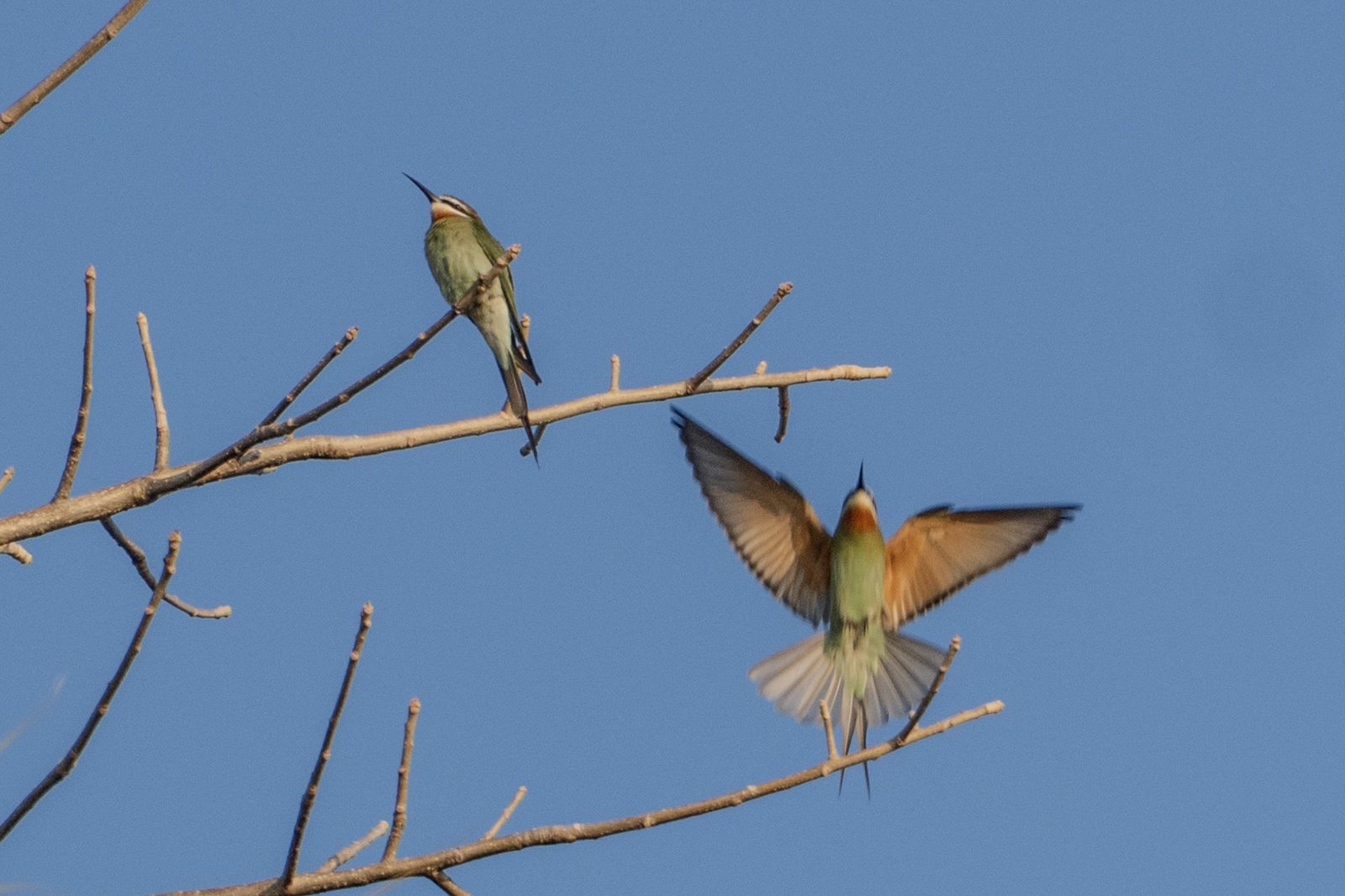
Photo: (c) Nathan Sarrazin, some rights reserved (CC BY) · CC-BY (May be cropped or resized)
Merops superciliosus
Conservation status: Unknown
Basic stats
Diet
Invertebrates
Habitat
Grassland, coastal mountain forest and sandy scrub near water
Range
Eastern and southern Africa, coastal Angola, Madagascar and the Comoros
Clutch size
4 eggs
Size
23–26cm
Weight
Averages about 39g
The Olive Bee-eater is a 23–26 cm bee-eater, with central tail streamers extending beyond the rest of the tail. Adults of both sexes have bronzy-green plumage and an olive crown, with white facial markings across the forehead, eyebrow and lower face. Blue colours the rump and most of the tail, while the elongated streamers are black. AVONET records an average mass of about 39 g (Wikipedia, general species account; AVONET, Tobias et al. 2022).
Its range covers eastern and southern Africa, an isolated coastal population in Angola, Madagascar and the Comoros. Grassland, coastal mountain forest and sandy scrub near water provide habitat. EltonTraits assigns its diet wholly to invertebrates. Populations are partly migratory, with many birds shifting north during the southern dry season. Four eggs are laid in a nesting burrow around the beginning of the southern African wet season (Wikipedia, general species account; EltonTraits, Wilman et al. 2014).
Where to see Olive Bee-eater in Kenya
GBIF records grouped by protected area. They show where the species has been reported, not that it is there now, and they are not population counts.
Recorded in 26 protected areas (1969–2026). The 8 with the most records:
- Tsavo West National Park: 372 records (1969–2025)
- Tsavo East National Park: 71 records (1969–2026)
- Lake Bogoria National Reserve: 26 records (1974–2024)
- Meru National Park: 21 records (1975–2025)
- Arabuko-Sokoke Forest Reserve: 20 records (1983–2024)
- Ndara Conservancy: 20 records (2010–2021)
- Nairobi National Park: 19 records (1987–2023)
- Masai Mara: 14 records (1998–2022)
Quick answers
- What does the Olive Bee-eater eat?
- Invertebrates
- What habitat does the Olive Bee-eater live in?
- Grassland, coastal mountain forest and sandy scrub near water
- Where is the Olive Bee-eater found?
- Eastern and southern Africa, coastal Angola, Madagascar and the Comoros
- How many eggs does the Olive Bee-eater lay?
- 4 eggs
- How big is the Olive Bee-eater?
- 23–26cm
- How much does the Olive Bee-eater weigh?
- Averages about 39g