
 Wildlife
of Kenya
Mesic Four-striped Grass Rat
Rodents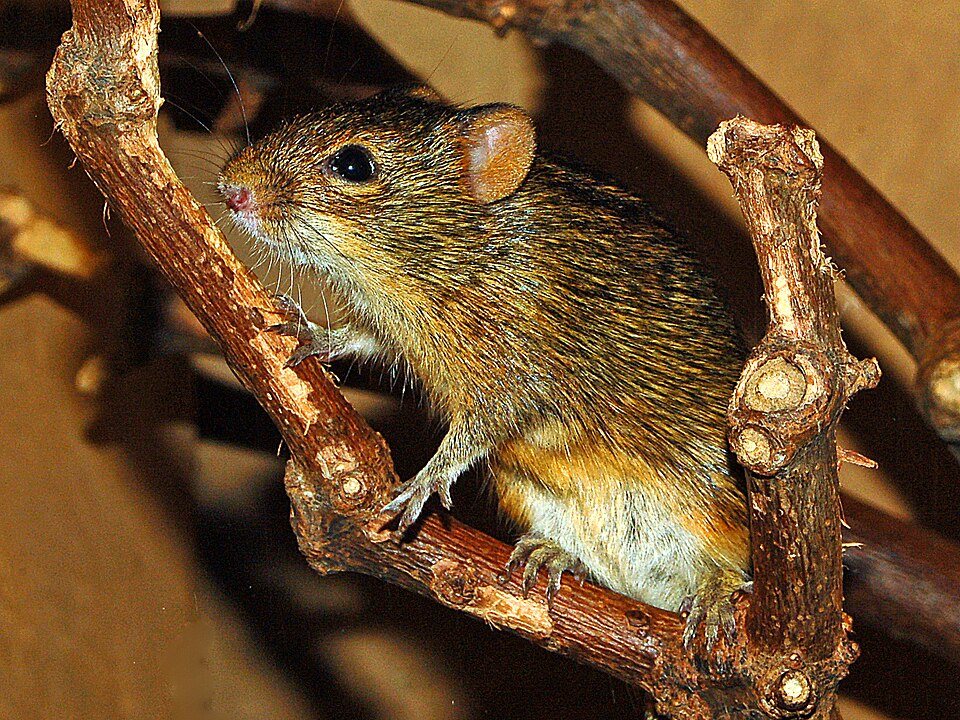
Photo: Hectonichus · CC BY-SA 3.0 (May be cropped or resized)
Rhabdomys dilectus
Conservation status: Unknown
Basic stats
Diet
Mainly wheat seeds, with plants, berries and small invertebrates
Habitat
Wetter mountain savanna, montane grassland and wetlands
Range
Throughout southern Africa
Size
Head and body 90–135mm, tail 80–135mm
Weight
Up to 68g (Wikipedia); 30–47g (GBIF)
The mesic four-striped grass rat is a fairly typical small murid, rather larger than a house mouse. Wikipedia gives its head and body as 90–135mm, its tail as 80–135mm and its foot as 17–33mm, with ears of 10.0–20mm. Weight is given as up to 68g by Wikipedia and as 30–47g by GBIF. The back is dark reddish-brown with black longitudinal stripes, which inspired the genus name meaning barred mouse. The underparts are paler, the legs are dark and grizzled, and the tail is shorter than the head and body (Wikipedia, general species account; GBIF description, Muridae).
It is found throughout southern Africa. Wikipedia places it in wetter mountain savannas up to 2,300m, while GBIF gives montane grassland, wetlands and Afro-alpine habitat up to 2700m. It often invades cultivated fields and may enter houses in towns. It is terrestrial, crepuscular and solitary, feeding mainly on wheat seeds and partly on plants, berries and small invertebrates. In mesic grassland it is territorial, with densities from 2 to 34 individuals per ha, and farmers regard it as a pest (Wikipedia, general species account; GBIF description, Muridae).
Where to see Mesic Four-striped Grass Rat in Kenya
GBIF records grouped by protected area. They show where the species has been reported, not that it is there now, and they are not population counts.
Recorded in 3 protected areas (1910–2015).
- Mount Elgon National Park: 37 records (2009–2011)
- Mount Kenya National Reserve: 16 records (1910–2015)
- Aberdare National Park: 9 records (2006)
Quick answers
- What does the Mesic Four-striped Grass Rat eat?
- Mainly wheat seeds, with plants, berries and small invertebrates
- What habitat does the Mesic Four-striped Grass Rat live in?
- Wetter mountain savanna, montane grassland and wetlands
- Where is the Mesic Four-striped Grass Rat found?
- Throughout southern Africa
- How big is the Mesic Four-striped Grass Rat?
- Head and body 90–135mm, tail 80–135mm
- How much does the Mesic Four-striped Grass Rat weigh?
- Up to 68g (Wikipedia); 30–47g (GBIF)