
 Wildlife
of Kenya
Marabou Stork
Storks, Herons, Ibises & Flamingos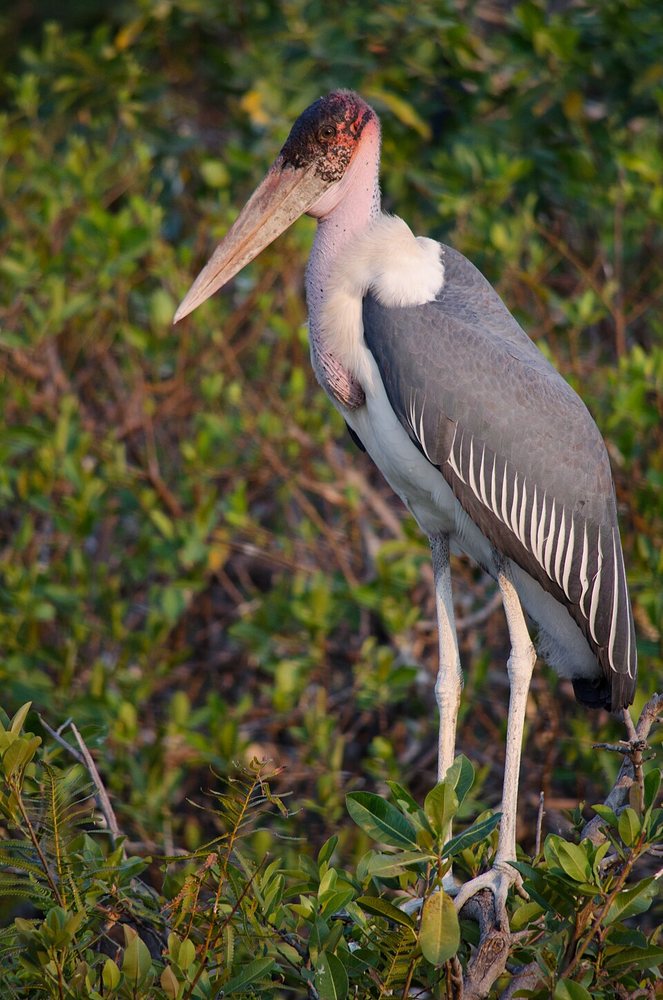
Photo: Benjamin Hollis from Seattle, WA, USA · CC BY 2.0 (May be cropped or resized)
Leptoptilos crumenifer
Conservation status: Unknown
Basic stats
Habitat
Wet and arid habitats
Range
Sub-Saharan Africa
Clutch size
Two or three eggs
Incubation period
30 days
Size
120–130cm
Wingspan
225–287cm
Weight
4.5–8kg
The Marabou Stork is native to sub-Saharan Africa and breeds in wet and arid environments, often near human habitation and landfill sites. Its silhouette combines cloak-like wings and back with skinny white legs and, at times, a large white tuft, giving the bird its “undertaker” nickname (Wikipedia, general species account).
Large specimens may reach 152 cm in height and 9 kg, although typical measurements are 120–130 cm long, 225–287 cm across the wings, and 4.5–8 kg. It feeds mainly on carrion, scraps, and faeces, but takes a broad range of animal food; in the dry season, pairs build tree nests and lay two or three eggs, which hatch after 30 days (Wikipedia, general species account).
Where to see Marabou Stork in Kenya
GBIF records grouped by protected area. They show where the species has been reported, not that it is there now, and they are not population counts.
Recorded in 93 protected areas (1913–2026). The 8 with the most records:
- Masai Mara: 3,495 records (1969–2026)
- Nairobi National Park: 2,607 records (1961–2026)
- Lake Nakuru National Park: 2,014 records (1969–2026)
- Mara Triangle: 1,052 records (1971–2026)
- Tsavo West National Park: 866 records (1966–2026)
- Buffalo Springs National Reserve: 759 records (1969–2026)
- Samburu National Reserve: 565 records (1973–2025)
- Tsavo East National Park: 396 records (1969–2026)
Quick answers
- What habitat does the Marabou Stork live in?
- Wet and arid habitats
- Where is the Marabou Stork found?
- Sub-Saharan Africa
- How many eggs does the Marabou Stork lay?
- Two or three eggs
- How long are the eggs of the Marabou Stork incubated?
- 30 days
- How big is the Marabou Stork?
- 120–130cm
- What is the wingspan of the Marabou Stork?
- 225–287cm
- How much does the Marabou Stork weigh?
- 4.5–8kg