
 Wildlife
of Kenya
Long-tailed Widowbird
Weavers, Waxbills & Whydahs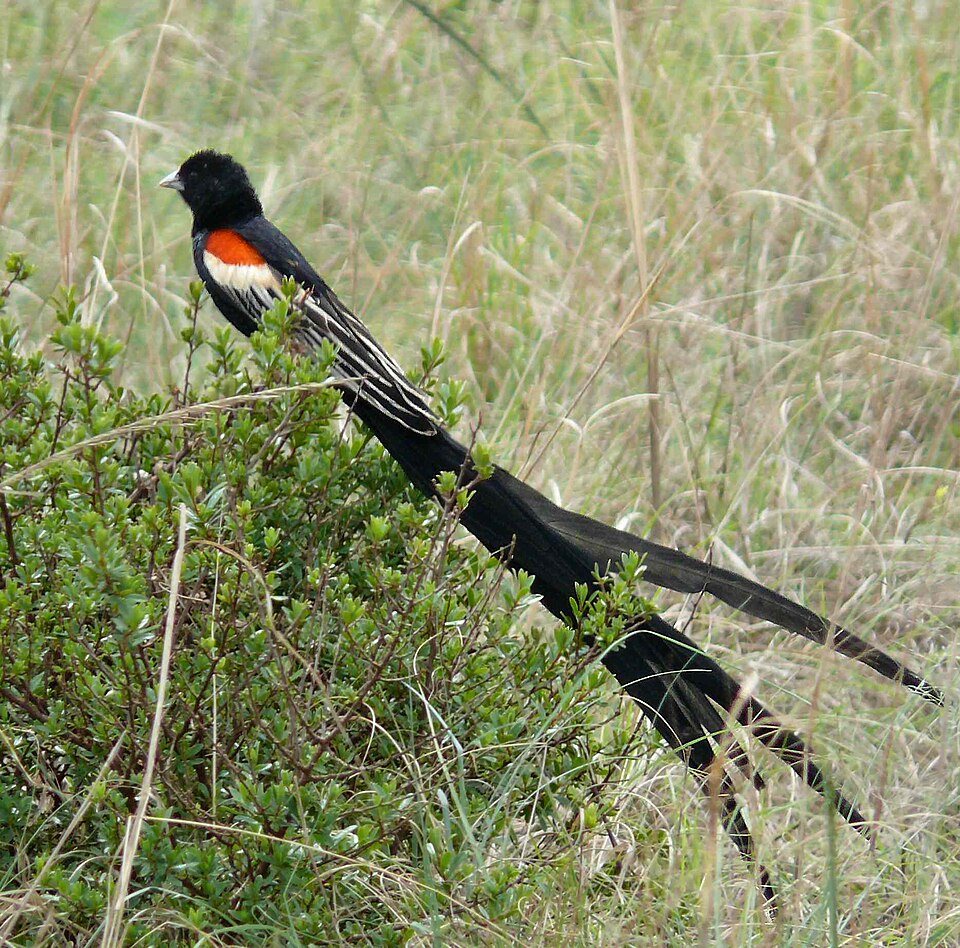
Photo: Mohanr53 at English Wikipedia · Public domain
Euplectes progne
Conservation status: Unknown
Basic stats
Diet
Seeds, with occasional arthropods
Habitat
Swampy grassland, highveld pasture and reedbeds
Range
Angola, Kenya, Lesotho, South Africa, Eswatini, Zambia, Botswana and the Democratic Republic of the Congo
Clutch size
1–3
Size
Females about 15cm; males up to 71cm including tail
Weight
33
The Long-tailed Widowbird is a striking grassland weaver. Breeding males are nearly black with orange-white shoulders and an exceptionally long broad tail; females are tawny and black-streaked with narrow tails. Three separated populations occur in eastern, central, and southern Africa, mainly in swampy grassland and highland pasture, with reedbeds used for roosting. (Wikipedia, general species account) (AVONET, Tobias et al. 2022)
Seeds dominate its diet, while arthropods are taken occasionally. Birds forage on the ground in flocks and males perform slow, tail-lowered display flights over territories. Females weave domed nests in tall grass, usually laying one to three eggs; breeding is concentrated from late summer into winter in the southern population. The long tail is central to the male's display. (Wikipedia, general species account) (EltonTraits, Wilman et al. 2014)
Where to see Long-tailed Widowbird in Kenya
GBIF records grouped by protected area. They show where the species has been reported, not that it is there now, and they are not population counts.
Recorded in 21 protected areas (1969–2026). The 8 with the most records:
- Lake Nakuru National Park: 323 records (1969–2024)
- Solio Ranch and Conservancy: 95 records (1993–2026)
- Ol Pejeta Conservancy: 44 records (1989–2026)
- Aberdare National Park: 27 records (1973–2024)
- Solio Game Park: 22 records (1997–2024)
- Segera Conservancy: 13 records (2003–2024)
- Mount Kenya National Reserve: 11 records (1985–2021)
- Soysambu Conservancy: 10 records (1998–2024)
Quick answers
- What does the Long-tailed Widowbird eat?
- Seeds, with occasional arthropods
- What habitat does the Long-tailed Widowbird live in?
- Swampy grassland, highveld pasture and reedbeds
- Where is the Long-tailed Widowbird found?
- Angola, Kenya, Lesotho, South Africa, Eswatini, Zambia, Botswana and the Democratic Republic of the Congo
- How many eggs does the Long-tailed Widowbird lay?
- 1–3
- How big is the Long-tailed Widowbird?
- Females about 15cm; males up to 71cm including tail
- How much does the Long-tailed Widowbird weigh?
- 33