
 Wildlife
of Kenya
Kori Bustard
Cranes, Rails & Bustards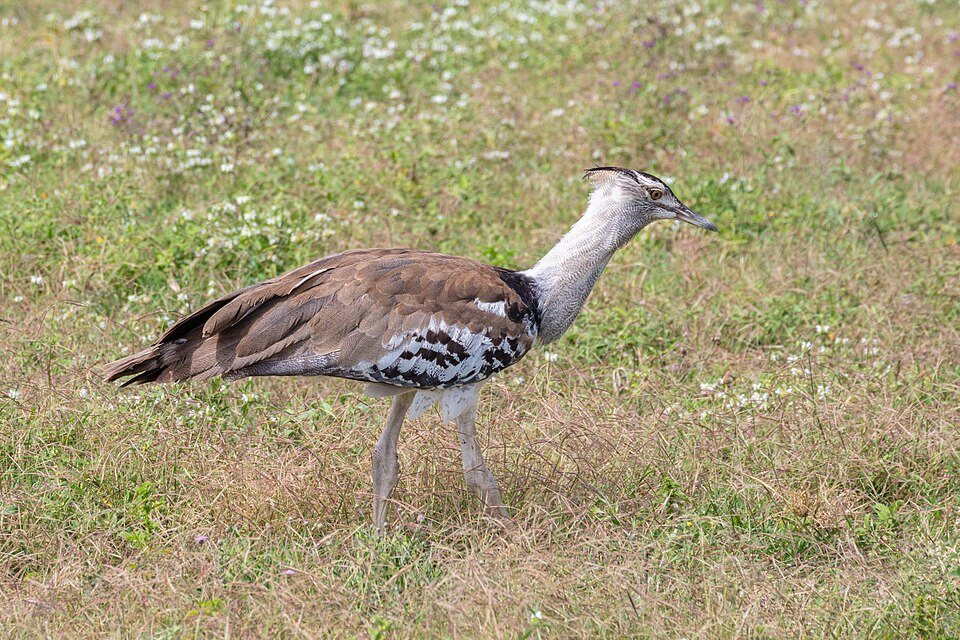
Photo: Diego Delso · CC BY-SA 4.0 (May be cropped or resized)
Ardeotis kori
Conservation status: Unknown
Basic stats
Diet
Invertebrates, fruit, seeds, plant matter and small vertebrates
Habitat
Dry open plains with scattered trees and scrub
Range
Eastern and southern Africa
Size
About 90–135cm
Wingspan
About 177–275cm
Weight
About 3–18kg
Kori Bustards are Africa’s largest flying birds, with males about 105–135 cm long and spanning roughly 230–275 cm; females are smaller at about 90–112 cm with a 177–220 cm span. Grey and brown plumage is finely patterned in black and white, and shaggy neck feathers, a dark crest and long yellowish legs give the bird a heavy profile (Wikipedia, general species account).
Dry open plains with scattered trees and scrub in eastern and southern Africa form the main habitat. Kori Bustards forage almost entirely on the ground for invertebrates, fruit, seeds, other plant material and small vertebrates. Males are among the heaviest animals capable of flight, commonly weighing about 7–18 kg, while females weigh roughly 3–7 kg. Usually quiet birds may produce a low, dry croak (Wikipedia, general species account; EltonTraits, Wilman et al. 2014; Collins Birds of the World).
Where to see Kori Bustard in Kenya
GBIF records grouped by protected area. They show where the species has been reported, not that it is there now, and they are not population counts.
Recorded in 94 protected areas (1930–2026). The 8 with the most records:
- Amboseli National Park: 1,096 records (1969–2025)
- Masai Mara: 969 records (1970–2024)
- Nairobi National Park: 554 records (1971–2026)
- Buffalo Springs National Reserve: 470 records (1969–2026)
- Samburu National Reserve: 464 records (1970–2026)
- Tsavo East National Park: 435 records (1969–2026)
- Ol Pejeta Conservancy: 321 records (1992–2026)
- Mara Triangle: 261 records (1971–2024)
Quick answers
- What does the Kori Bustard eat?
- Invertebrates, fruit, seeds, plant matter and small vertebrates
- What habitat does the Kori Bustard live in?
- Dry open plains with scattered trees and scrub
- Where is the Kori Bustard found?
- Eastern and southern Africa
- How big is the Kori Bustard?
- About 90–135cm
- What is the wingspan of the Kori Bustard?
- About 177–275cm
- How much does the Kori Bustard weigh?
- About 3–18kg