
 Wildlife
of Kenya
Hamerkop
Storks, Herons, Ibises & Flamingos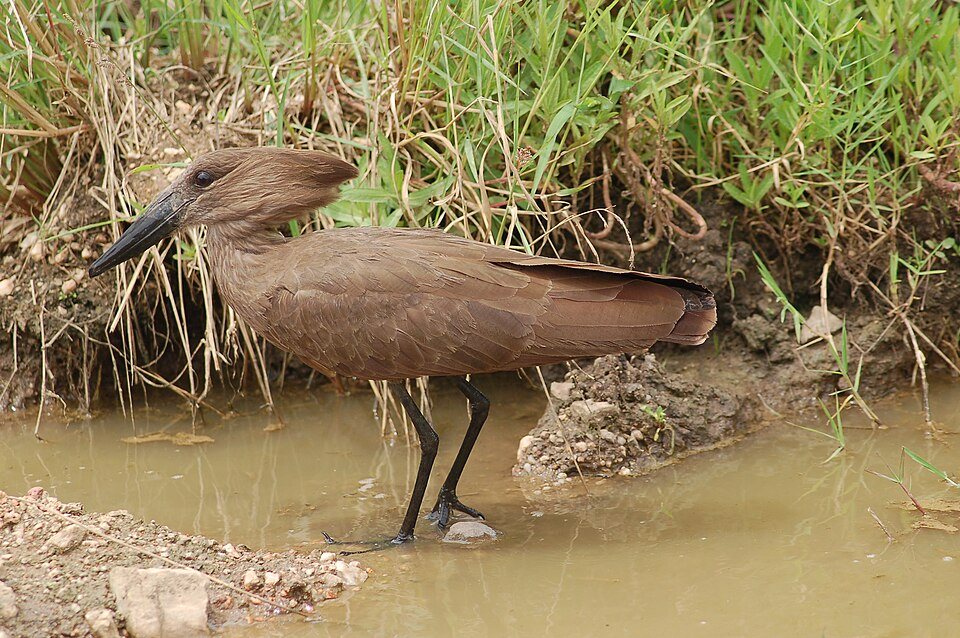
Photo: Joachim Huber · CC BY-SA 2.0 (May be cropped or resized)
Scopus umbretta
Conservation status: Unknown
The hamerkop occurs in mainland Africa, Madagascar and Arabia, using many wetland types: estuaries, lake margins, fish ponds, riverbanks and rocky coasts. Its long bill and rear crest create a hammer-shaped head, which inspired the Afrikaans name “hammerhead.” Once grouped with Ciconiiformes, it and its family are now placed in Pelecaniformes; its closest relatives are thought to be pelicans and the shoebill. Scopus and Scopidae each contain only this living species. (Wikipedia, general species account)
It is sedentary but often moves locally. It usually hunts in shallow water, by sight or touch, and eats mainly fish and amphibians, though it can take any available prey. During breeding it builds several of its famously enormous nests. (Wikipedia, general species account)
Where to see Hamerkop in Kenya
GBIF records grouped by protected area. They show where the species has been reported, not that it is there now, and they are not population counts.
Recorded in 124 protected areas (1956–2026). The 8 with the most records:
- Masai Mara: 3,142 records (1971–2026)
- Nairobi National Park: 1,882 records (1970–2026)
- Mara Triangle: 1,374 records (1971–2026)
- Lake Nakuru National Park: 883 records (1969–2026)
- Amboseli National Park: 476 records (1962–2026)
- Buffalo Springs National Reserve: 344 records (1969–2026)
- Tsavo West National Park: 310 records (1966–2025)
- Samburu National Reserve: 286 records (1970–2026)