
 Wildlife
of Kenya
Great Spotted Cuckoo
Cuckoos & Coucals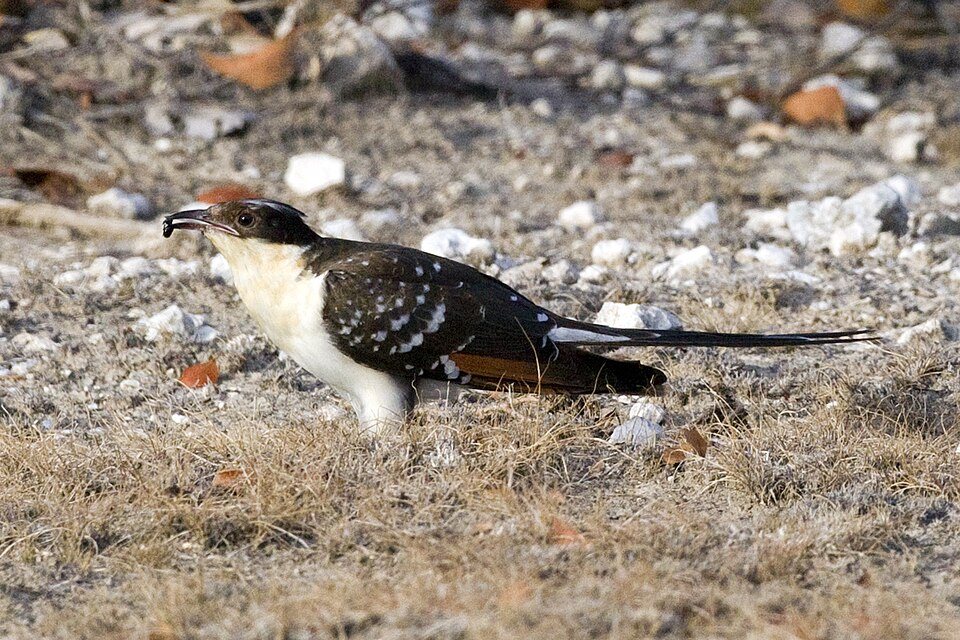
Photo: Yathin S Krishnappa · CC BY-SA 3.0 (May be cropped or resized)
Clamator glandarius
Conservation status: Unknown
Basic stats
Diet
Insects, spiders and small reptiles
Habitat
Warm open country with trees
Range
Africa and Mediterranean Basin
Size
35–39cm
Weight
Averages about 143g
The Great Spotted Cuckoo is a slender bird 35–39 cm long, with broad wings and a long, narrow tail. Adults are grey above with a grey cap, yellowish face and upper breast, and white underparts. The sexes resemble each other. Juveniles have darker upperparts and chestnut flight feathers. AVONET records an average mass of 143 g (Wikipedia, general species account; AVONET, Tobias et al. 2022).
It occurs widely in Africa and the Mediterranean Basin, using warm open country with trees. Its prey includes insects, spiders, small reptiles and hairy caterpillars. A brood parasite, it lays in the nests of corvids, particularly magpies. Cuckoo chicks can compete strongly with their hosts' young, but also release a repellent when threatened that can help protect the nest from predators (Wikipedia, general species account).
Where to see Great Spotted Cuckoo in Kenya
GBIF records grouped by protected area. They show where the species has been reported, not that it is there now, and they are not population counts.
Recorded in 34 protected areas (1977–2024). The 8 with the most records:
- Masai Mara: 90 records (1981–2024)
- Samburu National Reserve: 79 records (1977–2024)
- Nairobi National Park: 66 records (1983–2024)
- Buffalo Springs National Reserve: 65 records (1982–2024)
- Tsavo West National Park: 61 records (1983–2024)
- Tsavo East National Park: 43 records (1987–2024)
- Meru National Park: 41 records (1978–2024)
- Mara Triangle: 24 records (1981–2024)
Quick answers
- What does the Great Spotted Cuckoo eat?
- Insects, spiders and small reptiles
- What habitat does the Great Spotted Cuckoo live in?
- Warm open country with trees
- Where is the Great Spotted Cuckoo found?
- Africa and Mediterranean Basin
- How big is the Great Spotted Cuckoo?
- 35–39cm
- How much does the Great Spotted Cuckoo weigh?
- Averages about 143g