
 Wildlife
of Kenya
Great Frigatebird
Seabirds & Cormorants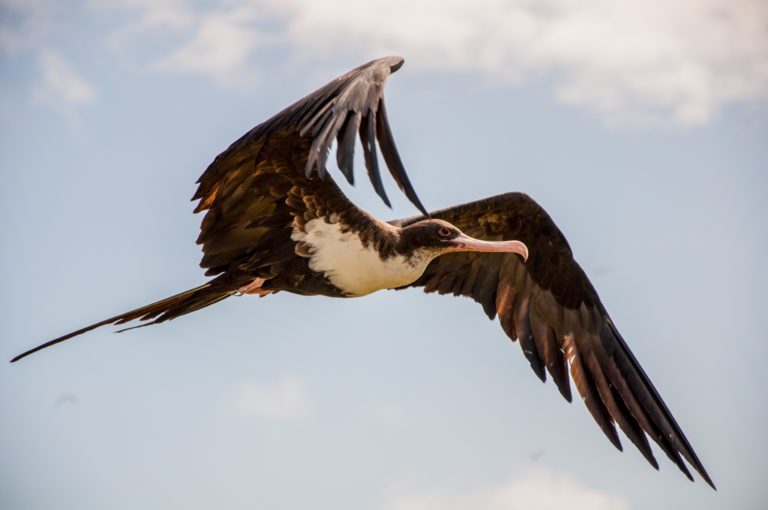
Photo: James Weaver · CC BY 4.0 (May be cropped or resized)
Fregata minor
Conservation status: Unknown
Basic stats
Diet
Mostly fish, especially flying fish, plus squid and other marine prey
Habitat
Tropical open ocean and remote nesting islands
Range
Tropical Pacific and Indian oceans, with a small South Atlantic population
Clutch size
1 egg
Incubation period
About 56 days
Size
85–105cm
Wingspan
205–230cm
Weight
Averages about 1275g
The Great Frigatebird is a very lightly built tropical seabird with long pointed wings and a deeply forked tail. Adult males are black with a glossy green sheen and inflate a red throat pouch during courtship. Larger females have a white throat and breast, while juveniles show a pale head and throat tinged with rust. It measures 85–105 cm, spans 205–230 cm and averages about 1,275 g (Wikipedia, general species account; AVONET, Tobias et al. 2022).
Across tropical parts of the Pacific and Indian oceans, the species ranges widely from island colonies; a much smaller population occurs in the South Atlantic. It catches prey without settling on the sea, snatching flying fish, other fish and squid at or just above the surface, sometimes around tuna or dolphins. Theft from other seabirds supplements rather than dominates its feeding. Colonies form on remote islands, and each nesting attempt has a single egg incubated for about 56 days (Wikipedia, general species account; EltonTraits, Wilman et al. 2014; AnAge).
Quick answers
- What does the Great Frigatebird eat?
- Mostly fish, especially flying fish, plus squid and other marine prey
- What habitat does the Great Frigatebird live in?
- Tropical open ocean and remote nesting islands
- Where is the Great Frigatebird found?
- Tropical Pacific and Indian oceans, with a small South Atlantic population
- How many eggs does the Great Frigatebird lay?
- 1 egg
- How long are the eggs of the Great Frigatebird incubated?
- About 56 days
- How big is the Great Frigatebird?
- 85–105cm
- What is the wingspan of the Great Frigatebird?
- 205–230cm
- How much does the Great Frigatebird weigh?
- Averages about 1275g