
 Wildlife
of Kenya
Dideric Cuckoo
Cuckoos & Coucals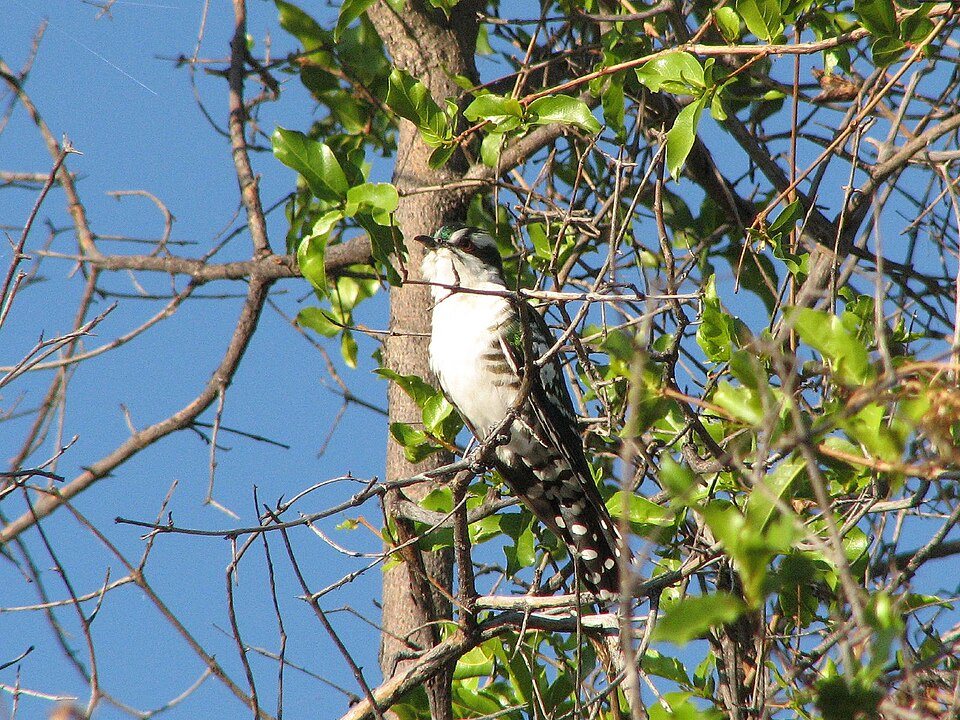
Photo: Flickr user Alastair Rae . Photo uploaded to commons by user ltshears · CC BY-SA 2.0 (May be cropped or resized)
Chrysococcyx caprius
Conservation status: Unknown
Basic stats
Diet
Insects
Habitat
Woodland and scrub
Range
Sub-Saharan Africa
Weight
About 33g
The Dideric Cuckoo, also spelled Diederik Cuckoo, is a sub-Saharan African cuckoo. It is a brood parasite, laying its eggs in the nests of other bird species rather than building its own nest. It is a brood parasite and lays eggs in the nests of other birds. AVONET estimates its average mass near 33 g. (Wikipedia, general species account; AVONET, Tobias et al. 2022)
It feeds mainly on insects and is often heard before seen, giving a repeated, clear call. The male has glossy green upperparts and white markings, while the female is more subdued. Its clear repeated call is often heard in woodland and scrub during the breeding season. The measured wing is roughly 113 mm long. Its tail averages about 80 mm. (Wikipedia, general species account; AVONET, Tobias et al. 2022)
Where to see Dideric Cuckoo in Kenya
GBIF records grouped by protected area. They show where the species has been reported, not that it is there now, and they are not population counts.
Recorded in 118 protected areas (1930–2026). The 8 with the most records:
- Nairobi National Park: 815 records (1973–2024)
- Tsavo West National Park: 627 records (1969–2024)
- Lake Nakuru National Park: 367 records (1969–2025)
- Kagamega Forest: 261 records (1983–2024)
- Tsavo East National Park: 202 records (1963–2024)
- Amboseli National Park: 190 records (1971–2024)
- Masai Mara: 177 records (1977–2024)
- Buffalo Springs National Reserve: 176 records (1969–2026)
Quick answers
- What does the Dideric Cuckoo eat?
- Insects
- What habitat does the Dideric Cuckoo live in?
- Woodland and scrub
- Where is the Dideric Cuckoo found?
- Sub-Saharan Africa
- How much does the Dideric Cuckoo weigh?
- About 33g