
 Wildlife
of Kenya
Bronze Mannikin
Weavers, Waxbills & Whydahs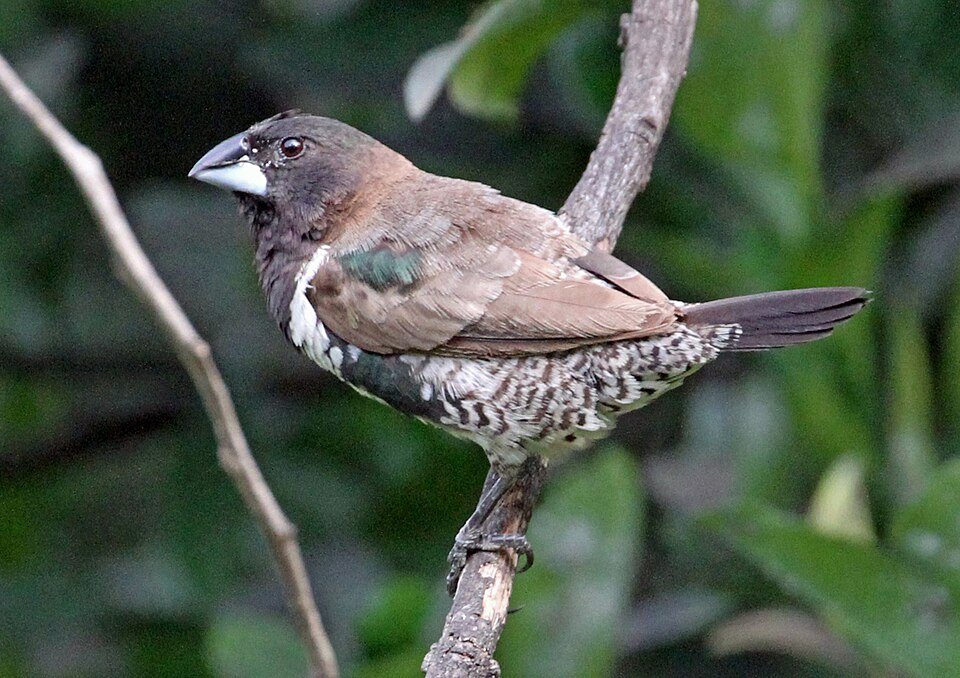
Photo: gisela gerson lohman-braun · CC BY-SA 2.0 (May be cropped or resized)
Spermestes cucullata
Conservation status: Unknown
The bronze mannikin is a highly social estrildid finch, locally common to scarce across much of sub-Saharan Africa. It stays year-round in some places, while elsewhere it wanders or irrupts, using moist savannas and forest edges. Of four munia species on mainland Africa, it is both smallest and most widely distributed; the others are the black-and-white, red-backed and magpie mannikins. It shares the Comoro Islands with the Madagascar mannikin and was introduced to Puerto Rico. In West Africa it can be a pest in grain and rice fields. (Wikipedia, general species account)
People also trap it locally for the pet trade. This is among the smallest munias: adults measure 9–10 cm and weigh 7–12 g. The compact body has a short black tail and stubby bills with black and pale gray coloring, without a distinct bluish cast. (Wikipedia, general species account)
Where to see Bronze Mannikin in Kenya
GBIF records grouped by protected area. They show where the species has been reported, not that it is there now, and they are not population counts.
Recorded in 56 protected areas (1969–2026). The 8 with the most records:
- Nairobi National Park: 1,433 records (1970–2026)
- Masai Mara: 437 records (1977–2026)
- Kagamega Forest: 346 records (1981–2024)
- Arabuko-Sokoke Forest Reserve: 249 records (1973–2024)
- Mara Triangle: 236 records (1981–2026)
- Lake Nakuru National Park: 182 records (1969–2024)
- Watamu Marine National Park: 175 records (1977–2024)
- Mount Kenya National Reserve: 147 records (1985–2024)