
 Wildlife
of Kenya
Blue-cheeked Bee-eater
Bee-eaters, Rollers & Kingfishers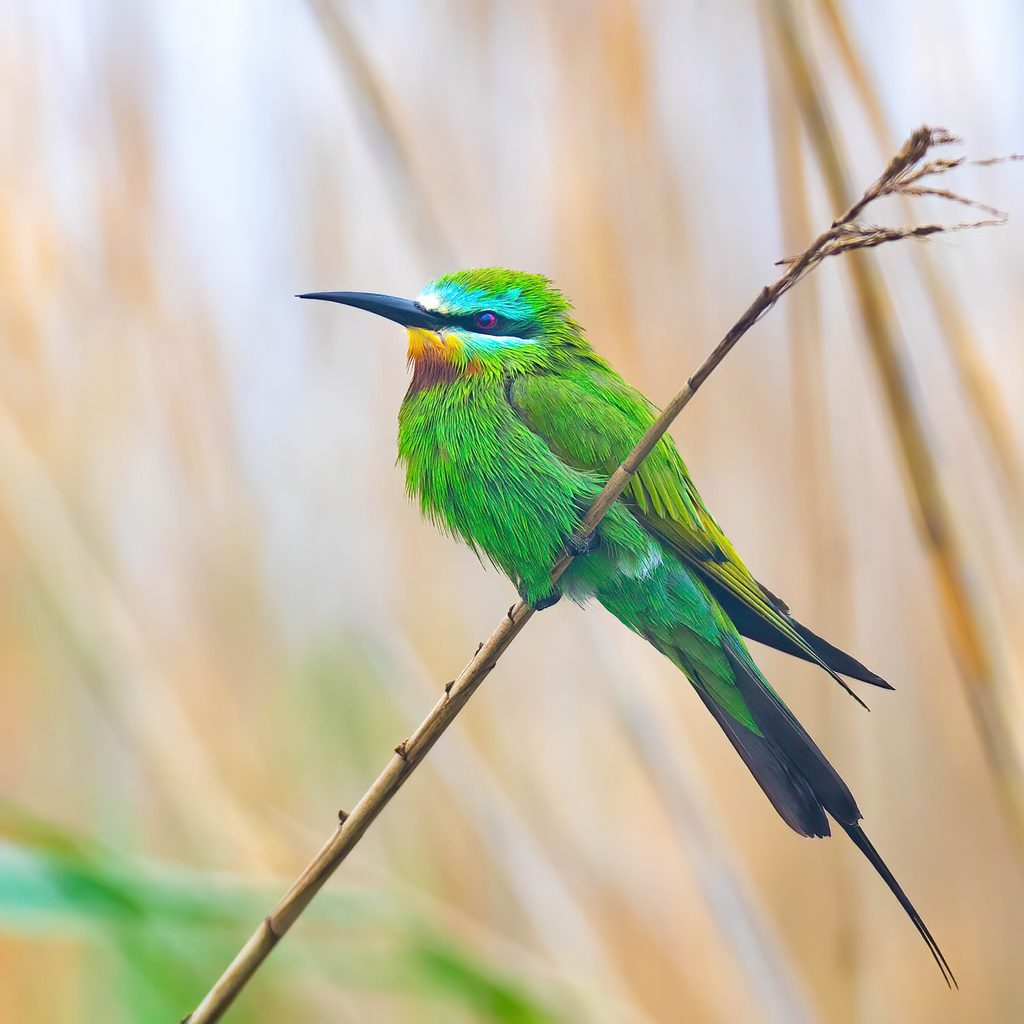
Photo: egorbirder · CC BY 4.0 (May be cropped or resized)
Merops persicus
Conservation status: Unknown
Basic stats
Diet
Flying invertebrates
Habitat
Semi-desert, sandy scrub and scattered trees near water; winters in open woodland and grassland
Range
Breeds from North Africa and the Middle East to Kazakhstan and western India; winters mainly in tropical Africa
Clutch size
4–8 eggs, usually 6–7
Incubation period
About 23–26 days
Size
27–31cm
Weight
Averages about 49g
The Blue-cheeked Bee-eater is a slender green bird measuring 27–31 cm, with elongated central tail feathers that can add about 7 cm. Blue facial sides, a black eye stripe, yellow-and-brown throat and long black bill make the head distinctive. The sexes are similar, although females have shorter tail streamers. AVONET records an average mass of about 49 g and classifies the species as strongly migratory (Wikipedia, general species account; AVONET, Tobias et al. 2022).
It breeds from North Africa and the Middle East to Kazakhstan and western India, with most populations wintering in tropical Africa. Semi-desert, sandy scrub and scattered trees near water are used in summer, while open woodland and grassland serve in winter. Flying invertebrates form the entire EltonTraits diet profile, especially dragonflies, bees and wasps caught from exposed perches. A long tunnel in sand holds four to eight eggs, usually six or seven, incubated for 23–26 days (Wikipedia, general species account; EltonTraits, Wilman et al. 2014).
Where to see Blue-cheeked Bee-eater in Kenya
GBIF records grouped by protected area. They show where the species has been reported, not that it is there now, and they are not population counts.
Recorded in 32 protected areas (1976–2026). The 8 with the most records:
- Tsavo West National Park: 167 records (1979–2024)
- Tsavo East National Park: 65 records (1990–2024)
- Meru National Park: 48 records (1976–2024)
- Amboseli National Park: 41 records (1999–2024)
- Lake Bogoria National Reserve: 31 records (1999–2023)
- Watamu Marine National Park: 24 records (1988–2024)
- Arabuko-Sokoke Forest Reserve: 23 records (1988–2024)
- Taita Hills Wildlife Sanctuary: 21 records (1983–2024)
Quick answers
- What does the Blue-cheeked Bee-eater eat?
- Flying invertebrates
- What habitat does the Blue-cheeked Bee-eater live in?
- Semi-desert, sandy scrub and scattered trees near water; winters in open woodland and grassland
- Where is the Blue-cheeked Bee-eater found?
- Breeds from North Africa and the Middle East to Kazakhstan and western India; winters mainly in tropical Africa
- How many eggs does the Blue-cheeked Bee-eater lay?
- 4–8 eggs, usually 6–7
- How long are the eggs of the Blue-cheeked Bee-eater incubated?
- About 23–26 days
- How big is the Blue-cheeked Bee-eater?
- 27–31cm
- How much does the Blue-cheeked Bee-eater weigh?
- Averages about 49g