
 Wildlife
of Kenya
Black-tailed Gerbil
Rodents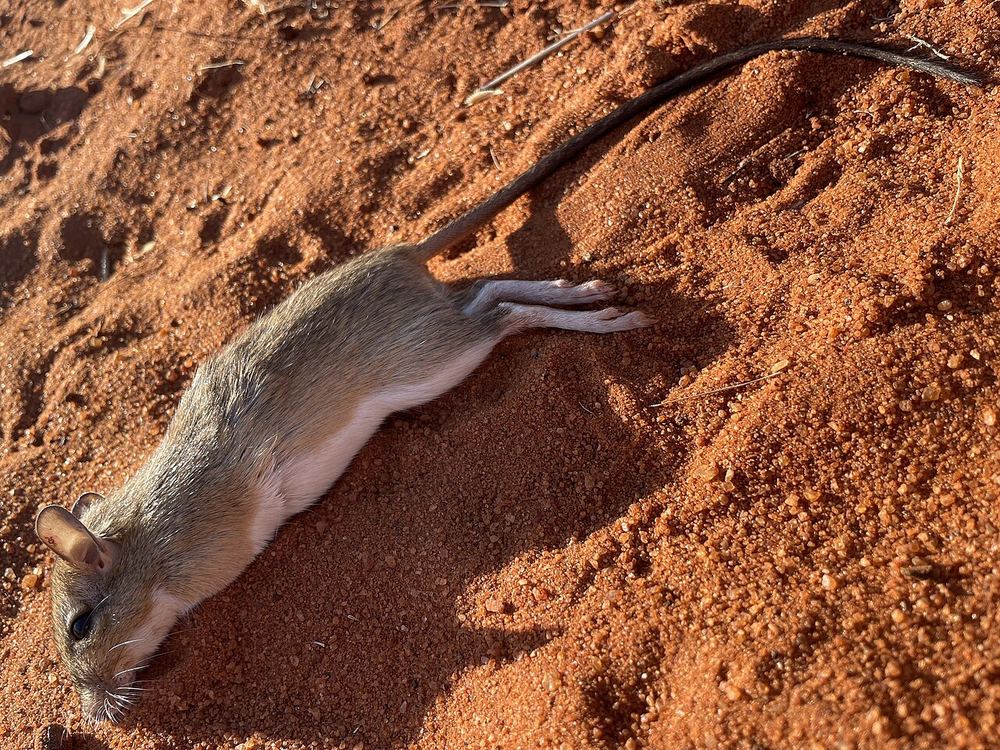
Photo: Stephanie Dolrenry · CC BY-SA 4.0 (May be cropped or resized)
Gerbilliscus nigricaudus
Conservation status: Unknown
Basic stats
Diet
Insects in the dry season, with seeds and plant matter in the wet season
Habitat
Open woodland, bush thickets and grassland up to 1500m
Range
Ethiopia, Kenya, Somalia and Tanzania
Size
Head and body 130–193mm, tail 170–208mm
Weight
80–195g
The black-tailed gerbil is a large gerbil with brown upperparts, white underparts and a long black tail, about 110% of head-and-body length. Its head and body measure 130–193mm, its tail 170–208mm, and it weighs 80–195g. Females are smaller than males. Two subspecies are described: the nominate nigricaudus is larger, with a tail black above and below, while nyama is smaller with a tail that is not fully black underneath. It belongs to the genus Gerbilliscus (Wikipedia, general species account; GBIF description, Muridae).
It is recorded in Ethiopia, Kenya, Somalia and Tanzania, where it lives in dry savanna, dry shrubland and arable land, and in open woodland, bush thickets and open grassland up to 1500m. It is omnivorous and its diet shifts with the seasons: insects can make up as much as 90% in the dry season, supplemented by seeds and forbs, while vegetable matter rises to around 50% in the wet season. Females can breed all year, with peaks linked to the two wet seasons of the year, and each female can carry one to eight embryos (Wikipedia, general species account; GBIF description, Muridae).
Where to see Black-tailed Gerbil in Kenya
GBIF records grouped by protected area. They show where the species has been reported, not that it is there now, and they are not population counts.
Recorded in 3 protected areas (1960–1975).
- Meru National Park: 4 records (1975)
- Lumo Conservancy: 4 records (1960)
- Tsavo West National Park: 2 records (1964)
Quick answers
- What does the Black-tailed Gerbil eat?
- Insects in the dry season, with seeds and plant matter in the wet season
- What habitat does the Black-tailed Gerbil live in?
- Open woodland, bush thickets and grassland up to 1500m
- Where is the Black-tailed Gerbil found?
- Ethiopia, Kenya, Somalia and Tanzania
- How big is the Black-tailed Gerbil?
- Head and body 130–193mm, tail 170–208mm
- How much does the Black-tailed Gerbil weigh?
- 80–195g