
 Wildlife
of Kenya
Black-and-white-casqued Hornbill
Hornbills & Hoopoes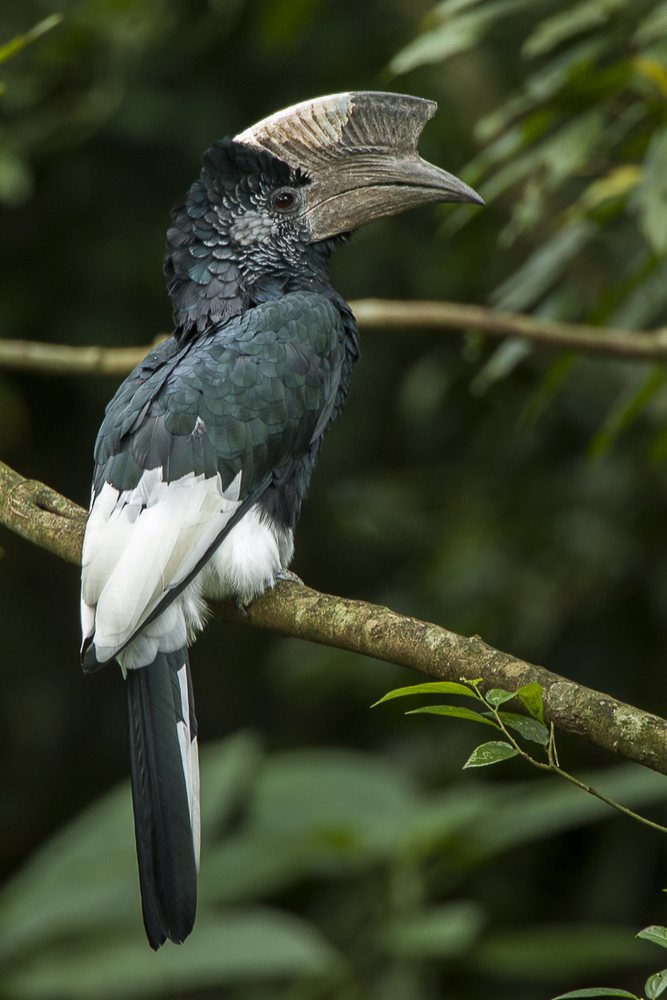
Photo: Francesco Veronesi from Italy · CC BY-SA 2.0 (May be cropped or resized)
Bycanistes subcylindricus
Conservation status: Unknown
The Black-and-white-casqued Hornbill is a large hornbill with black upperparts and white lower plumage, a heavy bill and a broad casque. The female has a smaller casque and a black bill. Adults measure about 60–70 cm, with a wingspan of roughly 70–96 cm; the AVONET mean mass is about 1,195 g. Its eyes are unusually mobile within the sockets (Wikipedia, general species account; AVONET, Tobias et al. 2022).
It occupies wooded habitats in central and western Africa, especially moist forest and surrounding areas. Figs and other fruit dominate the diet, while insects and small animals are also taken; EltonTraits records fruit as the principal component. Pairs nest in suitable tree cavities, and the usual clutch is no more than two eggs. The species is arboreal and generally associated with forest rather than open ground (Wikipedia, general species account; EltonTraits, Wilman et al. 2014).
Where to see Black-and-white-casqued Hornbill in Kenya
GBIF records grouped by protected area. They show where the species has been reported, not that it is there now, and they are not population counts.
Recorded in 11 protected areas (1957–2025). The 8 with the most records:
- Kagamega Forest: 2,588 records (1967–2025)
- Masai Mara: 275 records (1976–2024)
- Mara Triangle: 141 records (1981–2024)
- South Nandi Forest Reserve: 54 records (1957–2024)
- Saiwa Swamp National Park: 45 records (1977–2023)
- Mount Elgon National Park: 26 records (1989–2024)
- Masai Moran Conservancy: 23 records (1995–2024)
- Oloisukut Conservancy: 9 records (1986–2019)