
 Wildlife
of Kenya
African Pied Wagtail
Larks, Pipits & Wagtails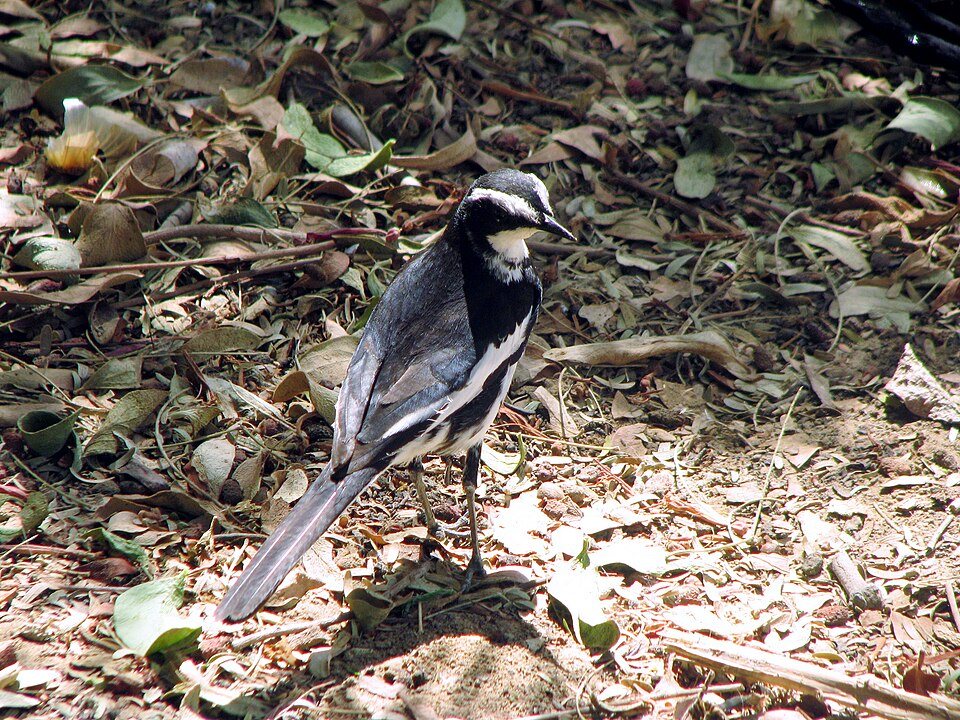
Photo: mr_fab · CC BY-SA 4.0 (May be cropped or resized)
Motacilla aguimp
Conservation status: Unknown
The African Pied Wagtail has black upperparts against white underparts, plus a white eyebrow and a white patch visible on the folded wing. Young birds are grayer; nominate birds have gray flanks. Across sub-Saharan Africa it ranges northward from the Eastern Cape to far southern Egypt; westward, it extends from Guinea toward western Eritrea and Somalia. Vagrants have reached Burkina Faso, The Gambia, Mauritania, Uganda, and the Western Cape (Wikipedia, general species account).
It uses seasonally wet or flooded subtropical and tropical lowland grasslands, rivers, and sometimes freshwater marshes. In some places it lives alongside people in villages and towns. In Malawi, breeding starts before the rains and carries on into the wet season, spanning six months and peaking in March and October. Both sexes build the nest and feed the young, but only females incubate (Wikipedia, general species account).
Where to see African Pied Wagtail in Kenya
GBIF records grouped by protected area. They show where the species has been reported, not that it is there now, and they are not population counts.
Recorded in 148 protected areas (1954–2026). The 8 with the most records:
- Kagamega Forest: 1,929 records (1973–2026)
- Nairobi National Park: 1,735 records (1970–2026)
- Masai Mara: 1,640 records (1976–2025)
- Mount Kenya National Reserve: 1,011 records (1983–2024)
- Lake Nakuru National Park: 797 records (1969–2024)
- Watamu Marine National Park: 652 records (1969–2024)
- Mara Triangle: 554 records (1976–2025)
- Tsavo West National Park: 518 records (1966–2024)